







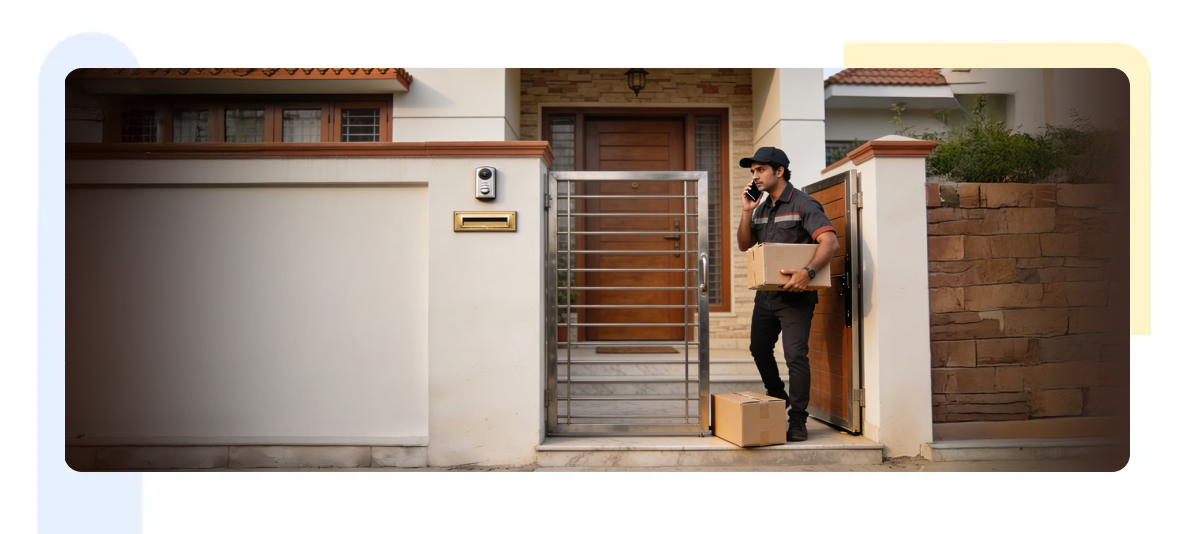

Every day, thousands of delivery personnel walk into India’s residential societies, corporate offices, and public spaces. Most of these entries are verified by a single guard, a paper register. That gap is quietly becoming a serious problem.
Think about this for a moment. It is 11 AM on Tuesday in any large residential complex in Pune, Noida, or Bengaluru. Three delivery riders are at the gate. Two more are waiting inside. A guard is on the phone with a resident who isn’t picking up. A package sits unclaimed near the security desk. And somewhere in the middle of all this, the actual job of monitoring who enters and exits the premises is being done by nobody.
This is not an exaggeration. This is Tuesday morning in urban India.
India’s e-commerce and app-based delivery ecosystem has grown at a pace that nobody in physical infrastructure design quite anticipated. What started as occasional online shopping orders has turned into a near-continuous flow of parcels, food deliveries, laundry bags, document couriers, and device exchanges moving in and out of buildings all day long. The buildings themselves, and the people managing them, have simply not kept up.
When Volume Meets Manual Verification, Things Break Down
Here is the thing about security systems: they work beautifully when they are lightly loaded. A guard checking one visitor every ten minutes can do a thorough job. They can verify ID, note the purpose of the visit, watch the person as they enter, and track when they leave. That is real security.
But ask the same guard to manage two delivery agents, a maintenance technician, a resident’s guest, and three parcel pickups simultaneously, and the system starts to crack. Shortcuts happen. Verifications become cursory. Records become incomplete. And then the risk starts to creep in.
This is not a criticism of security teams. It is a recognition that the tools they have been given were designed for a different era. A paper register and a clipboard were perfectly adequate when a building received four external visitors a day. They are completely inadequate when that number has climbed to forty or four hundred.
Worth knowing
Incidents reported in Pune involved individuals allegedly gaining entry into residential spaces while posing as delivery personnel. In Noida and Greater Noida, conflicts between delivery agents and security staff escalated into physical altercations following access disputes at residential complexes. These are not isolated anomalies. They are symptoms of a structural gap between delivery volumes and access infrastructure.
The Three Places Where Manual Access Is Failing
If you zoom out across the Indian landscape, three distinct environments are experiencing this same pressure in different ways.
Residential Societies
Gated communities and apartment complexes in Indian cities now function like small villages with their own economies. Grocery apps, food delivery platforms, pharmaceutical services, and courier companies all make regular runs to these complexes. The result is a gate that never really closes and a security desk that has quietly been converted into an informal logistics hub. Guards are storing parcels, fielding calls from residents, and trying to identify delivery personnel, all at once.
Enterprise and Hybrid Workplaces
Offices that have moved to hybrid work models face a different version of the same challenge. Employees come in on rotating schedules. Laptops, access cards, documents, and equipment need to move between people who may never be in the same building on the same day. The traditional “hand it to the receptionist” model becomes a coordination nightmare at scale, and it creates real accountability gaps when something goes missing.
High-Traffic Public Destinations
Pilgrimage sites, airports, transit hubs, and large public venues handle thousands of people carrying personal belongings. Manual baggage counters create queues, require significant staffing, and introduce human error into a process that should be simple and standardized.
“The problem is not that India has too many deliveries. The problem is that access into buildings has not evolved alongside the delivery economy.”
What a Smart Locker System Actually Does
The phrase “smart locker” tends to conjure up images of Amazon Hub terminals at supermarkets. That is a useful reference point, but the actual scope of what modern locker infrastructure does is considerably broader.
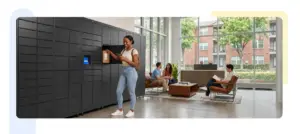
At its core, a smart locker system replaces a person-dependent decision with a system-verified interaction. Instead of a guard deciding whether to accept a package on behalf of a resident, the delivery agent places the package in a designated locker, the resident receives an authenticated notification, and they retrieve it using a secure access code or biometric verification. The interaction is logged automatically. No human intermediary is required at the point of handover.
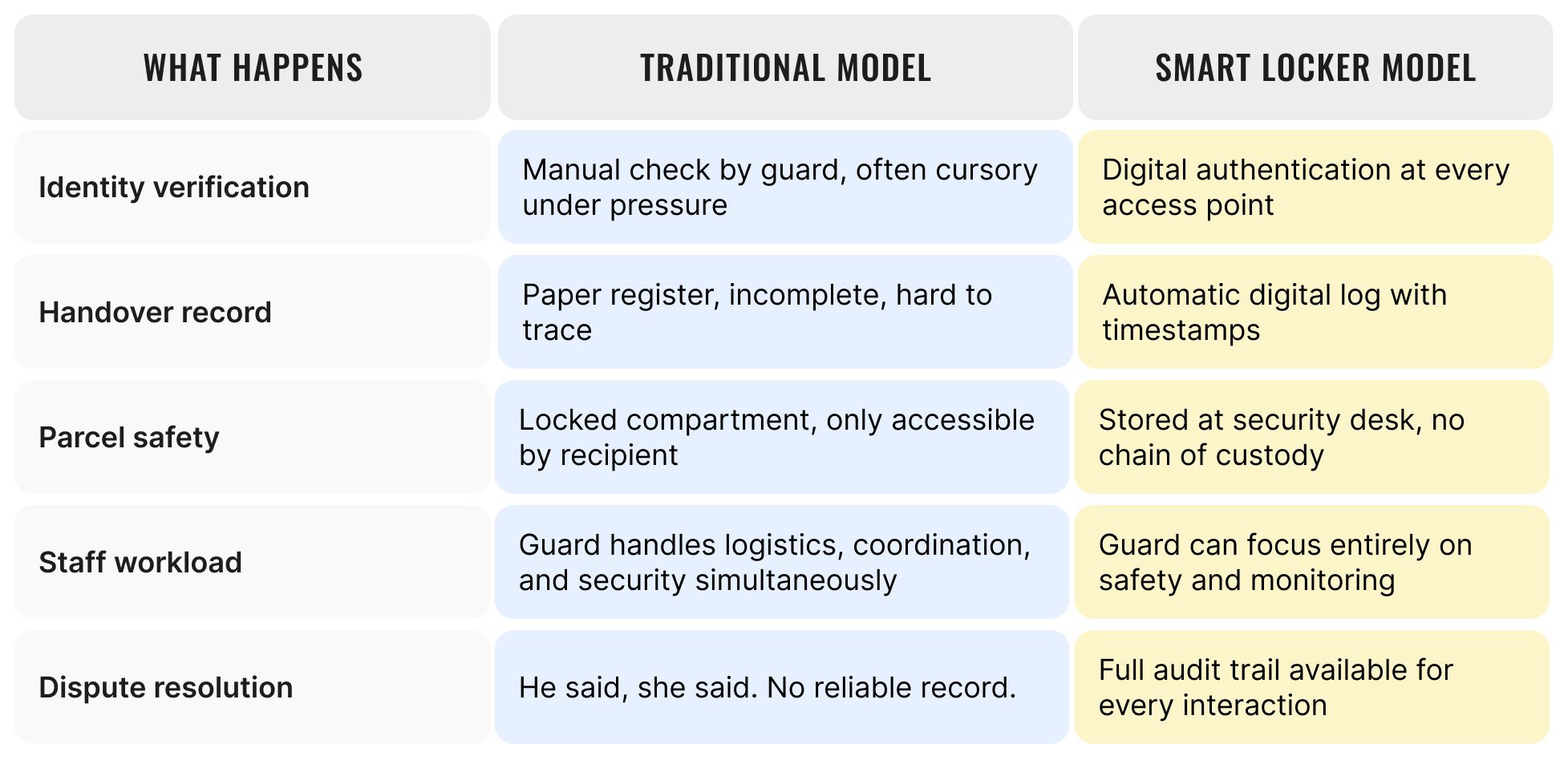
The shift sounds simple, but its implications are significant. Every stakeholder in the process gains something. Residents get certainty about their deliveries. Delivery agents complete their job without waiting for someone to pick up the phone. Security teams get their attention back. And building managers get an audit trail they can actually rely on.
Case Study: Vaishno Devi Pilgrimage Corridor
Real-World Deployment
Managing Millions of Visitors with Self-Service Storage Infrastructure
The Shri Mata Vaishno Devi pilgrimage is one of the most visited religious sites in India, receiving millions of pilgrims annually. Managing belongings for this volume of visitors under strict security conditions is a logistical challenge of significant scale.
Historically, pilgrims either carried their belongings through the entire journey, which added to physical strain, or relied on staffed manual baggage counters, which created congestion and placed enormous pressure on operations personnel.
Smartbox deployed a network of smart lockers across key access points along the pilgrimage corridor, enabling pilgrims to store their belongings securely using self-service authenticated access.
- Smoother crowd movement with reduced queue formation at storage points
- Automated locker allocation removing the need for staff intervention at every interaction
- Security personnel freed from baggage logistics to focus on crowd safety
- Pilgrims able to move more freely, completing the journey without carrying unnecessary weight
In this context, lockers were not just storage. They were crowd management infrastructure.
Why Most Organizations in India Have Not Made This Move Yet
Here is something worth being honest about. The adoption of smart locker systems in India remains low, and a big reason for that is perception rather than practicality.
Many facility managers and building committees still think of lockers as a convenience feature, the kind of thing you install in a gym changing room or a school corridor. The idea that locker infrastructure is actually a security and governance system, comparable in importance to CCTV or access card systems, has not yet taken root widely.
There are a few common mental blocks that come up repeatedly.
“Lockers are just for parcels.” In reality, smart locker deployments now cover banking documents, IT assets, visitor management, secure key exchange, and even evidence management in institutional settings.
“This is for large complexes only.” The operational benefits scale downward. Even a mid-sized office building or a residential complex with a few hundred units can see meaningful improvements in security and staff efficiency.
“Security is already handled by our guards.” Guards are people doing a difficult, high-pressure job. The question is not whether they are good at it but whether the infrastructure around them sets them up for success or failure.
“India’s security teams have not become less capable. They have just been asked to do far more, with the same tools from a different era.”
What This Means for India’s Infrastructure Future
There is a useful parallel worth drawing here. A decade ago, cash was still king across much of India’s commercial economy. Payments required human intermediaries, paper trails, and a lot of coordination. Then UPI happened, and the underlying infrastructure of financial transactions became standardised, fast, and auditable at scale.
Something similar is beginning to happen with physical access. As India’s urban buildings evolve into hybrid environments combining residences, logistics, workplaces, and services, the need for standardised access infrastructure becomes a structural necessity rather than a nice-to-have.
Smart locker systems are emerging as a foundational layer of this infrastructure. Not as a premium add-on for luxury complexes, but as a practical tool for any environment where interaction volumes have outpaced the capacity of manual systems to manage them safely.
India’s next infrastructure challenge is not just about moving goods efficiently from warehouse to doorstep. It is about managing how access happens within shared physical environments, consistently, verifiably, and without placing the entire burden of that responsibility on a single person at a gate.
What to Look for in a Smart Locker System
If you are evaluating locker infrastructure for a residential complex, corporate office, or public facility, a few things matter more than others.
Authentication quality. Can the system verify identities reliably across different user types, residents, delivery agents, visitors, and staff? A locker that opens with a simple PIN offers far less security than one using OTP verification, QR codes, or biometric confirmation.
Audit trail robustness. Every interaction should be automatically logged with a timestamp and user identification. This is what makes disputes resolvable and accountability real.
Integration with existing systems. The best deployments connect locker access to building management systems, delivery platform APIs, or enterprise HR systems so that the whole process flows without manual coordination at every step.
Scalability. Your building is not getting fewer deliveries next year. The system you install today should be able to grow alongside the demand it is managing.
· · ·
The Bottom Line
India’s delivery economy is not going to slow down. The volume of parcels, documents, assets, and goods moving through residential societies, offices, and public spaces will keep growing. The only real question is whether the access infrastructure inside buildings is going to grow with it, or keep falling further behind.
Smart locker systems are not a silver bullet, and nobody is suggesting that installing lockers is all a building needs to do to stay secure. But as one part of a broader access governance strategy, authenticated locker infrastructure gives every stakeholder, residents, security teams, delivery agents, and facility managers, something they currently lack: a process they can actually rely on.
In a country where physical infrastructure has consistently struggled to keep pace with digital adoption, getting this layer right matters more than it might appear from the outside. The technology is already here. The question is whether we are ready to take the manual out of access management.