


The Numbers Forcing Change…
- +56% rise in campus package volumes since 2021
- 3.2x more missed deliveries vs staffed mailrooms
- 92% of students prefer self-service collection
Let’s be direct. If your university is still relying on a staffed mailroom and a paper-based package logging system to manage student deliveries in 2026, you’re not just behind the curve. You are actively creating friction for students, burning through staff hours, and leaving your campus exposed to liability.
That’s not an exaggeration. It’s where the data points.
Package volumes on university campuses have surged year-round, not just during back-to-school rushes. Students are ordering everything: groceries, textbooks, prescription medication, and electronics. And they expect the same Amazon-speed, self-service convenience on campus that they get everywhere else. When that expectation is not met, they notice. When it keeps happening, it shows up in satisfaction scores.
The question is not whether your campus needs a modern package management solution. The question is how long you can afford to keep patching a system that was not built for 2026 volumes.
How Smart Lockers Are Transforming the Modern University Experience
Universities and other education institutions are increasingly adopting smart locker solutions to improve campus operations and enhance the student experience. With growing demand for flexible learning environments, digital services, and secure access to resources, smart lockers for universities provide a convenient way to manage devices, deliveries, and personal belongings.
Unlike traditional storage options, modern intelligent lockers offer automated access, secure storage, and real-time management capabilities. These solutions allow students to collect laptops, tablets, documents, and other essential items without depending on manual assistance from university staff.
By integrating technology-driven locker systems across campuses, universities can create a more efficient, secure, and student-friendly environment.
The Mailroom Is Broken. Everyone Knows It.
Campus mailrooms were designed for a different era. An era where a student might receive the occasional birthday card and a box from home once a semester. Today, that same mailroom is being asked to process dozens, sometimes hundreds, of packages per day, per residence hall.
The staff working at those counters are stretched thin. They are logging packages manually, fielding “Where is my package?” enquiries, managing storage overflow, and trying to maintain a chain of custody that satisfies both students and data protection requirements. It is an operational pressure cooker, and it is entirely avoidable.
The Four Pressure Points
- Staff time drain: Average 3 to 5 minutes per package interaction, multiplied by hundreds of daily packages.
- Storage overflow: Uncollected packages pile up for days, consuming space and creating congestion.
- Zero visibility: No real-time tracking, no audit trail. Just a clipboard and a lot of assumptions.
- Hours mismatch: Couriers arrive at 7 am. Mailrooms open at 9 am. Deliveries sit unattended.
And here is the part that often goes unspoken: the liability of exposure. When a package goes missing or is collected by the wrong person, your institution is accountable. Without a digital chain of custody, proving what happened is nearly impossible.
Students Are Not Asking for Luxury. They Are Asking for the Basics.
The 2026 student cohort grew up with contactless everything. They have never had to queue at a bank, wait on hold, or deal with a gated process that did not have a self-service alternative. When they move into halls and discover that collecting a package means queuing at a window between 10 am and 4 pm, Monday to Friday, the frustration is immediate.
This is not an entitlement. It is an expectation.
The same student who can unlock their room with a tap, order food in seconds, and stream a lecture on demand should not have to reschedule their day around a mailroom.
Self-service locker access available 24/7 is not a premium feature. It is a baseline expectation.
Universities that have already deployed smart locker infrastructure consistently report two things: a sharp drop in mailroom enquiries and a measurable increase in student satisfaction. The correlation is difficult to ignore.
How University Smart Lockers Work
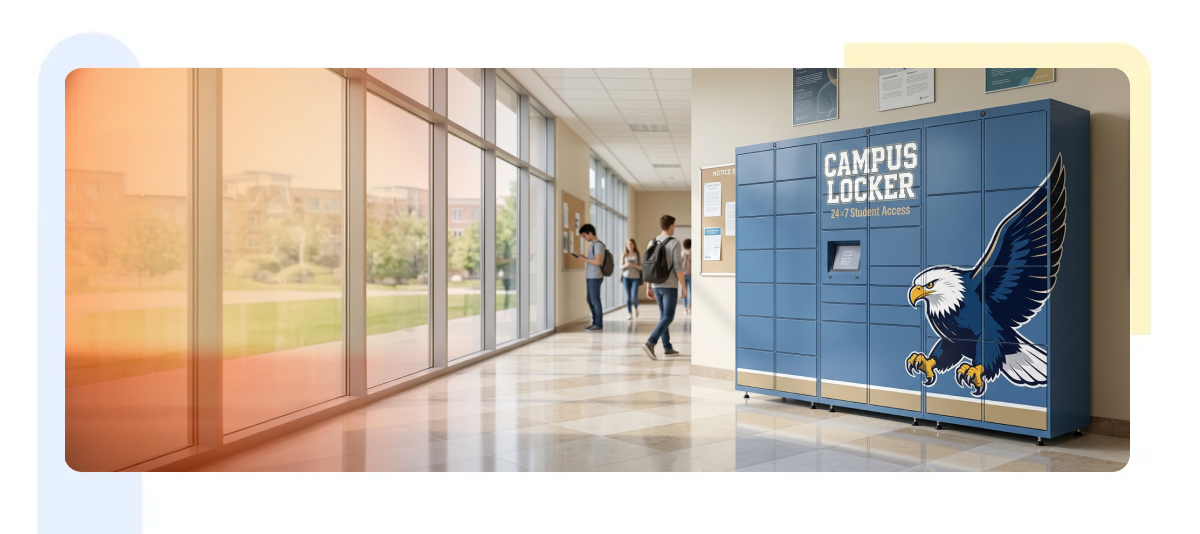
A university smart locker combines secure storage hardware with digital access technology to simplify campus asset management. Students can access assigned lockers using secure authentication methods, enabling quick and convenient collection of devices, packages, or learning resources.
These intelligent locker systems can automate device distribution by allowing universities to securely issue and collect laptops, tablets, and other technology equipment. Features such as QR code access, PIN authentication, automated notifications, and usage tracking make the process simple for both students and administrators.
Smart lockers can also support multiple departments, including IT services, libraries, student services, and administrative teams, creating a centralized solution for campus operations.
Benefits of Smart Lockers for Higher Education
For higher education institutions, smart locker technology provides several advantages:
- Improved student experience: Students can access required resources quickly without waiting for staff availability.
- Secure storage: Universities can protect valuable devices and equipment through controlled access and monitoring.
- Automated device management: Institutions can automate device distribution, collection, and inventory tracking.
- Support for multiple departments: A single locker solution can serve IT departments, libraries, administration teams, and student services.
- Flexible campus operations: Smart lockers help universities provide convenient self-service options across different campus locations.
As universities continue adopting digital-first solutions, smart lockers for schools and universities are becoming an essential part of modern campus infrastructure.
What Smart Lockers for Universities Actually Solve
Let’s be clear about what smart locker systems solve when implemented correctly:
- 24/7 secure self-collection: Students collect packages on their schedule. No staff required
- Full chain of custody: Every action is logged with timestamp, location, and identity
- Courier-direct deposit: No more unattended packages or missed deliveries
- Automated notifications: Students receive instant alerts, reducing enquiry volume significantly
- Real-time data: Operations teams get visibility into usage, occupancy, and trends
- Staff redeployment: Teams shift from repetitive handling to higher-value work
Smart lockers as Campus Infrastructure
Building a smart campus typically combines IoT sensors, unified communication platforms, digital ID/access systems, and automated service points like smart lockers. Smartbox lockers give universities a self-service layer for package pickup, IT device checkout, and mailroom automation, plugging into a campus’s broader smart-infrastructure stack without requiring students to be present during staffed hours.
The Volume Problem is No Longer Seasonal
There is a common misconception that package surges are limited to the start of term or holiday periods. That is no longer true.
Year-round residency, international student behavior, subscription commerce, and online retail have flattened the demand curve. Campuses are now operating at near-peak package volumes for most of the year.
This changes everything.
You are not solving for a temporary spike. You are solving for a permanent operational reality. And permanent problems require permanent infrastructure.
Scaling a manual system does not fix the issue. It simply increases pressure on staff, raises the risk of errors, and degrades service quality.
The system is the problem, not the people.
Why Smartbox is the Infrastructure Partner Universities Need in 2026
Smartbox Smart Lockers are designed specifically for the scale and complexity of university environments.
The deployment model is flexible. Indoor and outdoor units, modular configurations, and seamless integration with campus access systems and student IDs ensure adaptability across different campus setups.
Smartbox provides real-time dashboards that give operations teams full visibility. You know what is in the system, where it is, and how long it has been there. Alerts prevent package overflow. Analytics guide expansion decisions.
Integration is seamless. Smartbox works with existing campus systems, avoiding unnecessary complexity. Notifications align with existing communication channels. Adoption is smooth because usability is built into the system.
The Cost Conversation is Often Misunderstood
Most budget discussions start with installation costs. That is the wrong starting point.
The real comparison is the total cost of the current system:
- Staff hours spent on package handling
- Cost of lost or disputed deliveries
- Impact on student satisfaction and retention
- Space inefficiencies
When evaluated properly, the ROI becomes clear. For most mid-to-large campuses, the payback period falls within the first budget cycle.
There is also a reputational benefit. Campuses that deliver seamless experiences stand out. In a competitive education market, that matters.
What Forward-Thinking Campuses Are Already Doing
Universities that adopt smart lockers do not stop at pilot programs. They scale.
The pattern is consistent:
Initial deployment → rapid student adoption → reduced workload → campus-wide rollout.
Students adapt instantly. No training is required. No resistance. The shift happens naturally because the experience is better.
Operations teams see immediate impact. When enquiry volumes drop significantly, the difference is tangible.
The Standard Has Changed. Has Your Campus?
The future of campus services will depend on automation, accessibility, and smarter infrastructure. By implementing smart lockers for universities, education institutions can deliver secure, efficient, and technology-enabled experiences for students and staff.
From automated device management to secure storage and self-service access, intelligent lockers are helping universities create connected campuses that support the evolving needs of modern learners.
At the end of the day, this isn’t just about packages. It’s about the everyday experience your students have on campus. The small moments matter. The convenience of collecting a package without waiting. The reassurance that something important hasn’t been lost. The feeling that their time is respected.
Smart lockers for universities are no longer optional because student expectations have already moved ahead. Campuses that adapt are not just solving a logistics problem. They are quietly improving satisfaction, reducing stress, and creating a more seamless environment to live and learn in.
The technology is ready. The impact is immediate. The difference is visible.
The only question that remains is simple: when a better experience is this easy to deliver, how long should students have to wait for it?