


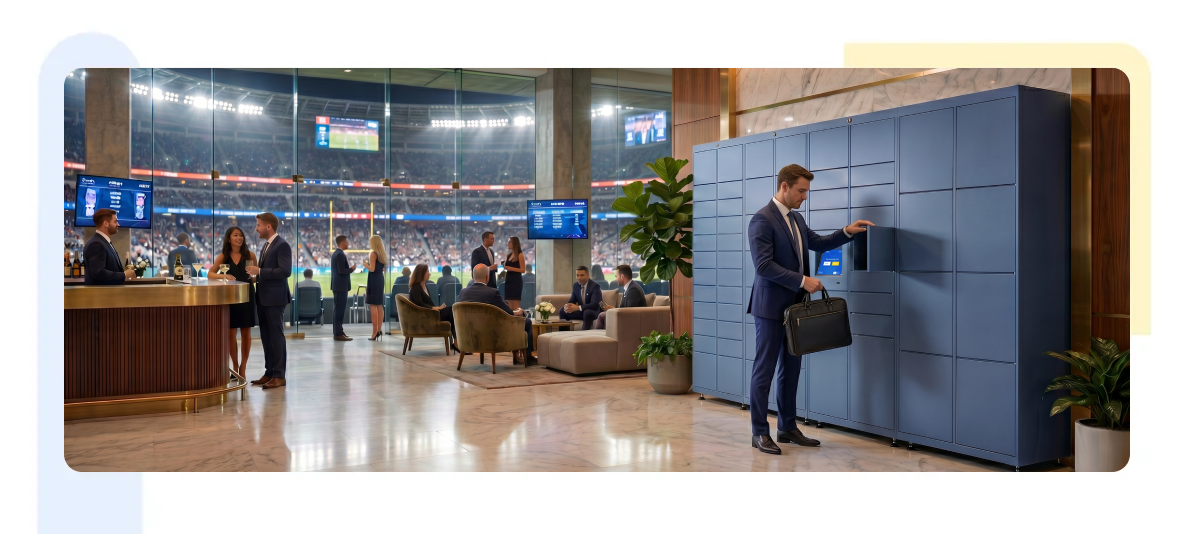

Ninety minutes before doors, the line outside a 16,000-seat arena already wraps the concourse. Most of it moves. Then it stops. A guest at the security checkpoint has arrived with a backpack that exceeds the venue’s bag policy, and there is nowhere to put it. The options are the ones every ingress team knows by heart: send her back to a car parked half a mile away, ask her to abandon the bag at the gate, or wave her through and absorb the risk.
None of those is a good outcome. Multiply that single interaction across a few hundred guests on a sold-out night, and the bag policy stops being a security measure and starts behaving like a bottleneck. This is one of several operational problems that hospitality smart lockers are designed to absorb, and increasingly, venue operators are realizing that the same infrastructure solving the bag problem also handles staff device handoff, exhibitor storage, VIP pickups, and the lost-property workload that quietly drains hours from every event.
What follows is a working guide for the people who actually run these buildings. Not a feature list, but a look at where the friction lives, why it lives there, and how a single layer of automated storage changes the math.
Why Modern Event Venues Need More Than Traditional Storage
The coat check is one of the oldest service models in hospitality, and for decades it worked. A guest hands over a coat or a bag, takes a numbered ticket, and retrieves the item later. The model has a structural flaw that becomes obvious only at scale: it is staffed, it is synchronous, and it fails at exactly the moment demand peaks.
Think about egress. A concert ends and 14,000 people stand up at the same time. A meaningful share of them want their belongings back inside a ten-minute window, and the cloakroom that managed arrivals comfortably over two hours now has to process a wall of people in minutes. You can throw labor at it, but labor is the constraint operators are trying to reduce, not expand.
Several pressures have converged to make the old model untenable. Event attendance has grown, and with it the volume of bags, coats, and personal items that need somewhere to go. Security regulations have tightened, so more items are stopped at the door than ever before. Staffing has gotten harder and more expensive to schedule, particularly for the part-time, peak-load roles that cloakrooms and bag-drops depend on. And guest expectations have shifted toward the kind of contactless venue operations people now take for granted everywhere else, from airport check-in to hotel mobile keys.
Traditional venue storage was never built for any of this. It assumes a person behind a counter and a guest willing to wait twice. The newer expectation is that storage should be available on demand, accessible without a queue, and accountable enough to survive an audit. That is a different category of infrastructure.
How Hospitality Smart Lockers Work
The mechanics are simpler than the technology behind them, which is the point. A guest or staff member is granted access to a compartment, uses it, and the system records every step. The experience should feel closer to using a parcel locker than operating software.
Access is digital. Instead of a physical token, a guest receives a QR code or a one-time PIN, usually delivered to a phone the moment a locker is assigned. That credential opens a specific compartment for a specific window of time. Time-based access is what makes the model work for events: a locker rented for a single performance expires when the event does, which means the system can recover and reassign capacity without a staff member walking the bank to check.
Notifications carry the operational weight that a cloakroom attendant used to. The guest is told when their locker is ready, reminded before the event ends, and prompted if an item is still inside after closing. For contactless guest pickup, the same credential that locked the door opens it again, with no counter, no ticket, and no line.
Underneath all of it sits an audit trail. Every open and close is logged with a timestamp and an identity, which matters far more for staff use cases than for guests. When a tablet goes missing, the question is never “where is it” in the abstract. It is “who had it last, and when,” and the log answers that in seconds.
The better platforms integrate outward rather than living in isolation. Ticketing systems can issue locker access alongside an event credential. Access control and CRM tools can recognize a VIP and pre-assign storage before they arrive. None of this needs to be technical to the operator. The right smart locker platform handles the plumbing and surfaces only what the floor team needs to see.
Smart Locker Use Cases in Hospitality and Events
The reason these systems earn their footprint is that one bank of lockers rarely does one job. The same hardware shifts roles across the event lifecycle and across the building.
Bag Storage
This is the anchor use case, and it looks different in every setting. At a concert, the demand is concentrated and predictable, with a heavy egress spike. At a festival, guests often want multi-day storage and the ability to swap items between sets, which favors larger compartments and rolling access windows. Convention centers see steadier, all-day demand from attendees who do not want to carry laptop bags and coats through eight hours of sessions. Sporting venues deal with the bag-policy problem most acutely, because the security line and the storage need are the same moment.
In all of these, the operational gain is the same. Event lockers turn an attended, queue-prone service into a self-service one that absorbs its own peaks, which is precisely where the traditional cloakroom breaks.
Prohibited Item Storage
This is the use case operators underestimate until they run the numbers on turn-aways. Security checkpoints exist to stop certain items, but they were never designed to do anything with those items once stopped. The result is a daily stream of guests forced to choose between abandoning a possession and missing part of the event.
Placing a locker bank just outside the security perimeter changes the entire interaction. A guest with a non-compliant bag, a professional camera, or another restricted item stores it in seconds and proceeds through screening clean. Venue prohibited items management stops being a confrontation at the gate and becomes a short detour. Confiscation volume drops, amnesty bins shrink, and the security line keeps moving because the awkward conversations resolve themselves at a locker rather than at the magnetometer.
Staff Asset Handoff
Walk into any control room at shift change and you will see the problem. Radios, handheld scanners, POS tablets, master keys, and uniforms move between people on paper sign-out sheets, if they are tracked at all. Devices walk off. Chargers go missing. The morning supervisor inherits a count that may or may not be right.
Smart lockers turn this into a closed loop. A device is checked into a compartment at the end of a shift and checked out by name at the start of the next. Because every transaction is logged, staff asset tracking lockers create accountability that a clipboard never could. The audit trail tells you who held what and for how long, which both deters loss and resolves disputes without a manager playing detective. For venues running hundreds of devices across multiple shifts, this is often where the system pays for itself first.
Exhibitor Material Storage
Anyone who has managed a trade show floor knows the between sessions scramble. Exhibitors finish a session and have nowhere secure to leave printed collateral, samples, demo units, and personal bags, so they either carry everything or risk leaving it at an unattended booth. Dedicated compartments for exhibitor materials let them store what they need on the floor, retrieve it for the next session, and stop hauling boxes through crowded halls. It is a small convenience that materially changes how an exhibitor experiences your venue.
VIP Services
Premium guests are precisely the people you least want standing in a will-call line. Lockers let a venue stage credentials, welcome kits, merchandise, gifts, and hospitality pass in advance, then release them to the right guest with a single code. A VIP arrives, taps a compartment, and collects everything waiting for them without a desk, a host, or a wait. VIP convenience delivered this way feels considered rather than transactional, and it frees premium-service staff to spend their time on hospitality instead of handing out lanyards.
Temporary Guest Storage
Plenty of storage needs are short and situational. A guest arrives early before a hotel event space opens. A conference attendee checks out of their room but has an evening session to attend. A visitor wants to drop a bag for two hours, not the whole day. Guest storage on a flexible, time-based model covers all of these without committing to a service desk to hold anyone’s belongings behind a counter.
Operational Benefits Beyond Guest Convenience
Guest experience is the visible win, but the operational case is what gets these systems approved. The benefits compound across departments.
Entry gets faster because the bag and prohibited-item friction that clogs security lines resolve before the checkpoint. Staffing pressure eases because self-service storage removes one of the most labor-intensive, peak-load roles in the building, and because the staff you keep can be redeployed to higher-value work. Queue management, the unglamorous discipline of moving people through doors, gets materially easier when one of its biggest stall points is automated.
Security improves in a quieter way. Fewer items pass into the venue that should not; fewer guests are turned away to create disruption outside, and every stored item carries a logged owner. The lost-property workload, which most operators treat as an unavoidable tax on every event, drops sharply when belongings live in assigned compartments with notifications rather than in a pile behind a desk.
Then there is consistency. A cloakroom is only as good as the people working it on a given night. An automated system performs the same way at the first event of the season and the last, across venues, across shifts. For multi-site operators, contactless venue operations delivered consistently is worth as much as the labor saved, because it makes the guest experience predictable in a business where predictability is hard to buy.
Can Event Venues Generate Revenue from Smart Lockers?
For most of their history, cloakrooms were a cost center. Smart lockers change the question, because the same infrastructure that reduces labor can also generate income, and the better operators treat it as both.
The most direct model is paid storage. Hourly and daily rentals turn what was a free, staffed service into a revenue line, and because the system is self-service, that revenue carries almost no marginal labor cost. Paid luggage storage is especially relevant for convention centers and hotels with event spaces, where attendees regularly have a gap between checkout and departure.
Premium tiers layer on top. Premium VIP storage, larger compartments, guaranteed availability, or a concierge add-on that returns a freshly charged phone with all command higher pricing from guests who value the convenience. Some venues package these as part of a premium ticket rather than charging at the locker, which folds the cost into product guests are already buying.
Sponsorship is where the model gets interesting. A locker bank is a high-dwell, high-visibility surface in a crowded concourse. Sponsor branding on the units and advertising on locker screens give partners a physical placement tied to a genuine guest service, which tends to sell better than generic signage. For a sponsor, “the official storage of [event]” is a real activation, not a logo on a wall.
Finally, there is a partnership model. Locker-as-a-service for events lets a promoter or event organizer deploy storage for a single show or season without owning the hardware, with revenue shared between the venue and the operator. This is how many venues pilot the concept before committing a permanent installation, and it lets the lockers prove their economics on someone else’s risk first.
Venue Locker ROI
It is tempting to reach for a headline percentage, but honest venue locker ROI is built from operational economics, not a single number on a slide. The savings come from several places at once, and their size depends entirely on your event profile.
Labor is the largest and most reliable line. A staffed cloakroom requires people scheduled precisely against peak demand, and peak-load part-time scheduling is both expensive and hard to fill. Replacing or shrinking that function removes a recurring cost that scales with every event you run. Lost-property handling is a smaller but persistent saving, because the hours spent logging, storing, and reuniting abandoned items shrink when belongings are stored in assigned, tracked compartments.
Security workload drops as turn-aways and confiscations fall, which is harder to put on a spreadsheet but real to anyone who has staffed a gate. Faster guest flow improves event throughput, and throughput has a quiet upside: guests who clear the door faster spend more time inside, where concessions and merchandise live. On the staff side, the audit trail reduces device shrinkage, and replacing lost scanners and tablets is a cost most operators have simply normalized.
The cleanest way to model it is to take your true cost of cloakroom and lost-property labor across a season, add a conservative estimate of device loss and security disruption, and weigh that against the system cost net of any storage or sponsorship revenue. For high-volume venues, the labor line alone often carries the case. The guest satisfaction gains and the new revenue are what turn a defensible investment into an obvious one.
Choosing the Right Hospitality Smart Locker Solution
Not every system suits every building, and the wrong choice tends to reveal itself at the worst moment. A few criteria separate infrastructure that lasts from hardware that disappoints.
Start with the environment. Outdoor banks at a stadium gate need genuine weatherproofing and durability against constant public handling, while indoor units in a hotel lobby or a premium concourse need to match the aesthetic of the space. The same product rarely does both well, so look for a range rather than a single form factor.
Then assess the software, because that is where most of the value and most of the failure modes live. Flexibility matters: can you reconfigure access rules, time windows, and pricing per event without calling a vendor? Scalability matters: can the platform run one site and one hundred from a single pane of glass? Integration matters: will it talk to your ticketing, access control, and CRM systems, or will it sit in a silo? Look closely at analytics and remote monitoring, because a system you cannot see into is one you cannot improve, and remote diagnostics are the difference between a locker outage you fix before doors and one guest report to you.
Security certifications and reliable support belong on the checklist for any installation that touches guest belongings and staff assets. So does multi-location management if you operate a portfolio, since managing each site separately erodes the consistency that justified the investment in the first place.
This is the frame within which to evaluate any vendor, including Smartbox. Smartbox builds hospitality solutions across exactly these settings, with durable hardware for public-facing environments, a configurable smart locker platform for access and analytics, and remote monitoring across multiple sites. The point is not the brand. The point is to hold whatever you choose to this standard.
A Layer of Venue Infrastructure, not a Storage Add-On
The most useful shift in thinking is to stop treating hospitality smart lockers as a better coat check. They are closer to a layer of venue infrastructure, in the same category as access control or point of sale, that happens to express itself as storage. One installation absorbs the bag-policy problem at security, the device-handoff problem at shift change; the exhibitor scrambles between sessions, the VIP pickup bottleneck, and the lost-property tax on every event.
What operators get in return is resilience. The building performs the same on a sold-out night as on a quiet one; the guest experience holds up without depending on who is staffing the counter, and the staff you keep spending their time where it matters. As event attendance grows and staffing stays tight, that combination of guest satisfaction, staff efficiency, and operational consistency is becoming part of how well-run venues are expected to operate, not a differentiator they advertise.
If you are evaluating how to modernize storage across your venue or your portfolio, it is worth seeing how smart storage and smart collect platform maps to your specific event profile. Contact Smartbox to walk through where the operational gains will land in your building.