


The New Reality of Apartment Living Begins at the Front Door
A resident’s experience of an apartment community is shaped by more than its architecture, amenities, or location. It is often defined by the little things that happen every day. A delivery arriving while someone is at work. A package waiting to be collected after a long commute. A package that cannot be found when it is needed most.
As online shopping becomes part of everyday life, package deliveries have become a permanent feature of residential operations. This makes a package management system for new apartments an important consideration for modern residential developments.
Simply put, a package management system is the infrastructure and process used to receive, secure, store, track, and distribute incoming deliveries within an apartment community. It can include a traditional apartment package room, a staffed receiving facility, or an automated solution powered by Smart Package Lockers.
For developers, the question is no longer whether residents will receive packages. It is how the community will manage them efficiently, securely, and without placing an unnecessary burden on property management teams.
And that decision is best made before the first resident moves in.
Why Package Management Is Becoming Essential in Residential Planning
Residential developments have traditionally been planned around familiar priorities: security, parking, recreational facilities, elevators, and shared spaces. Package receiving, however, has often been left to property managers to figure out after residents move in.
That approach is becoming increasingly difficult to sustain.
A single residential community may receive deliveries from multiple e-commerce platforms, grocery services, and courier companies every day. Packages arrive at different hours, in different sizes, and often when residents are unavailable to receive them.
Without a defined package setup, the responsibility frequently falls on security personnel or reception staff. Packages accumulate behind counters; common areas become temporary storage spaces, and residents depend on someone else to locate their deliveries.
This is where effective apartment mailroom management becomes important.
Before selecting a solution, developers should consider:
- Delivery volumes: How many packages is the community likely to receive daily?
- Storage requirements: How many packages may remain uncollected simultaneously?
- Security: Who can deposit, access, and collect packages?
- Resident convenience: Can residents collect deliveries outside conventional working hours?
- Operational efficiency: How much staff involvement is required?
- Future growth: Can the system accommodate increasing delivery volumes?
These considerations help developers move beyond simply allocating a room for packages and towards creating a more organized delivery management environment.
Understanding the Three Main Package Management Approaches
Not every residential community needs the same solution. A boutique apartment building with 40 households has different operational requirements from a large development with multiple towers and hundreds of residents.
Broadly, developers can consider three approaches: traditional package rooms, managed package rooms with staffed receiving, and automated package management systems.
- Traditional Apartment Package Rooms
The traditional apartment package room is perhaps the most familiar approach. A designated space is created within the building where delivery personnel can leave incoming packages for residents to collect.
It is relatively straightforward to establish and requires minimal technology.
However, simplicity can conceal operational complexity. As deliveries increase, packages need to be sorted, identified, organized, and monitored. Without a structured process, finding a particular delivery can become an exercise in searching through shelves and storage areas.
Where it works well:
- Smaller communities with manageable delivery volumes.
- Buildings with limited technology requirements.
- Properties with an existing package monitoring process.
Where challenges emerge:
- Packages may be misplaced or collected by the wrong person.
- Manual tracking offers limited visibility.
- Higher delivery volumes can overwhelm available storage.
- Residents may depend on room operating hours.
A traditional package room can be a practical starting point, but its long-term limitations deserve consideration.
- Managed Package Rooms and Staffed Solutions
Some residential communities prefer to keep package receiving under the supervision of a dedicated team.
Managed Package Rooms & Staffed Solutions introduce a human-controlled process in which receptionists, concierges, or designated personnel receive deliveries, organize packages, notify residents, and coordinate collection.
This approach offers a degree of personal assistance that technology alone may not replicate.
It works particularly well in luxury residential developments where concierge services are already part of the operating model.
However, staffing requirements can increase operational expenditure. Manual handling becomes demanding during peak periods, and package collection may depend on staff availability.
A managed package room can offer a premium receiving experience, but developers must consider whether the associated staffing model is sustainable over the long term.
- Smart Package Lockers: Bringing Automation to Everyday Deliveries
There is another way to approach the problem: reduce the need for manual intervention in routine package handling.
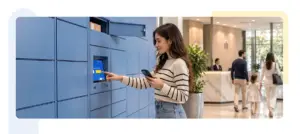
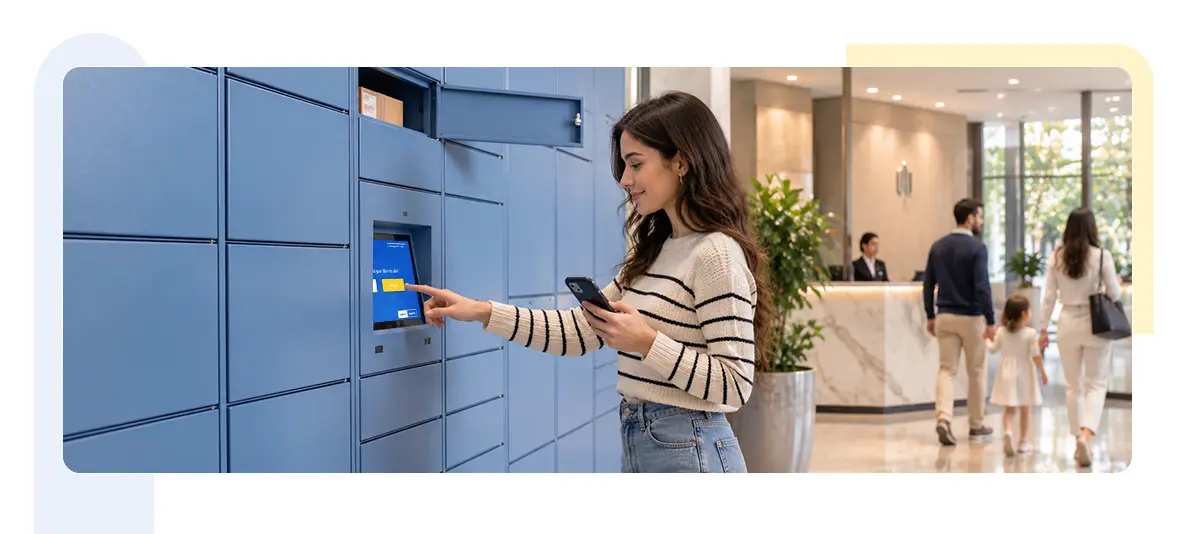
Smart Package Lockers provide individual electronic compartments where delivery personnel can securely deposit packages. Residents receive a notification, usually containing a unique OTP or access credential, which allows them to retrieve their packages independently.
The process is straightforward:
- The delivery person selects an available compartment.
- The package is placed inside and securely locked.
- The resident receives an automated notification.
- The resident enters the authorized access code.
- The compartment opens for collection.
This form of Automated Package Management can be particularly useful in larger residential communities, apartments with package lockers, and developments with limited reception staffing.
Developers should evaluate installation requirements, electrical and network infrastructure, compartment sizes, software capabilities, maintenance, and technical support before choosing a system.
The advantage is the ability to make package receiving a defined, technology-enabled part of residential operations from the beginning.
How Should a 200-Unit Apartment Community Plan Its Package Management?
Consider a residential development preparing to welcome its first 200 households.
The amenities have been planned, security systems are in place, and the property management team is preparing for occupancy. There is, however, one practical question: where will all the packages go?
Rather than choosing a package delivery box for apartments based solely on the number of units, the development team needs to understand how many deliveries the community might receive and how long those deliveries may remain uncollected.
Let’s consider a hypothetical planning scenario.
Step 1: Estimate daily delivery volumes
Assume each occupied apartment receives an average of half a package per day. For a 200-unit development, this translates to approximately 100 incoming packages daily.
This is an illustrative planning assumption, not an industry benchmark. Actual volumes will depend on occupancy, resident behavior, and delivery patterns.
Step 2: Calculate storage requirements
Not every resident collects a package immediately. Some may pick up deliveries within a few hours, while others may only return home the following day.
If packages remain uncollected for 24 to 48 hours, the community could need temporary capacity for approximately 100 to 200 packages.
This is why storage capacity should reflect collection patterns, not just daily delivery estimates.
Step 3: Account for package sizes
Residents receive everything from small packages containing accessories to larger boxes containing household products. A combination of compartment sizes can help accommodate different delivery requirements.
Step 4: Plan for peak periods
Festive seasons, online shopping events, weekends, and holidays can bring sudden increases in delivery volumes. A system designed only for average daily activity may struggle during these periods.
For this 200-unit development, the property team could consider a hybrid approach. Smart Automated Lockers could manage regular deliveries, while a designated area handles oversized packages.
The larger lesson is simple: package storage should be designed around the movement of packages through the building, not just the number of apartments within it.
What Should Developers Look for When Choosing a Package Management System?
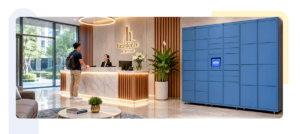
Once the operational requirements are clear, the next step is evaluating the system itself. A locker installation may look like a simple addition to a residential lobby, but behind it is a combination of hardware, software, security, and operational planning.
Here are the factors worth examining.
Security and controlled access
A reliable system should provide individual compartment access, unique collection credentials, and records of package deposits and collections. OTP-based access helps ensure packages are retrieved by authorized recipients.
Automated notifications
Residents should not have to call reception to ask whether a package has arrived. Automated notifications through SMS or other supported channels can inform them when deliveries are ready for collection.
Flexible compartment sizes
A one-size-fits-all approach rarely works. Developers should look for modular systems that accommodate different package dimensions and changing delivery requirements.
Convenient collection
Residents working late should not have to plan their day around reception timings. Self-service collection allows them to retrieve deliveries at a convenient time, subject to building access arrangements.
Integration and infrastructure
A modern Package Delivery System should be compatible with the building’s operational environment. Consider connectivity, software capabilities, and available integrations.
Durability and support
Evaluate material quality, environmental suitability, warranty coverage, maintenance requirements, and technical support. Residential infrastructure is expected to serve communities for years, making long-term reliability an important consideration.
Accessibility and placement
The location of the system matters as much as its functionality. Consider delivery access, resident movement, available floor space, reach requirements, and applicable accessibility standards.
Why Package Management Should Be Planned Before Construction Is Complete
There is a significant difference between installing a system because a building needs one and designing a building with that system in mind.
The first often involves compromises. The second creates opportunities.
When developers plan package management during construction, they can make decisions that would otherwise be difficult to accommodate later.
- Space planning: A dedicated apartment, package room or locker area can be incorporated into the building layout.
- Infrastructure: Electrical connections and network access can be considered early.
- Delivery access: Convenient routes can be identified without disrupting resident movement.
- Security integration: Package receiving can be considered alongside wider building access control.
- Future expansion: Modular configurations can be evaluated with changing occupancy and delivery volumes in mind.
For large residential developments, even a small operational inefficiency can become a recurring challenge across hundreds of households.
The best apartment communities package management approach is not necessarily the one with the most elaborate technology. It is the one that fits naturally into the way the building operates.
What Makes a Package Management System Worth the Investment?
The cost of a package management solution should not be evaluated in isolation. A more meaningful assessment considers the entire operating model.
For a staffed receiving arrangement, this includes personnel costs, time spent sorting packages, managing collection, and handling resident enquiries.
For a traditional package room, it includes space allocation, monitoring, organization, and the resources needed to manage increasing delivery volumes.
For automated systems, it includes hardware, installation, software, connectivity, maintenance, and technical support.
Developers should ask themselves:
- How much staff time will everyday package handling require?
- What happens when delivery volumes increase?
- Can residents collect packages without waiting for assistance?
- Can the system accommodate different package sizes?
- What is the recurring operating and maintenance costs?
A lower initial investment does not always translate into a lower long-term operating cost.
The objective should be to select a solution that balances upfront expenditure, ongoing requirements, security, and resident convenience.
Building a Better Residential Delivery Experience with Smartbox
A well-designed residential community should make everyday living feel effortless. Security should be dependable, shared spaces should serve a purpose, and something as routine as receiving a package should not become an operational challenge.
This is the thinking behind building our smart lockers.
Designed for residential communities, Smartbox brings secure, technology-enabled package receiving and collection into one integrated system.
Its capabilities include:
- Secure OTP-based collection: Individual access credentials help ensure packages are collected by authorized recipients.
- Automated notifications: Residents are informed when deliveries are ready for collection.
- Modular locker configurations: Different compartment sizes accommodate varying package requirements.
- Contactless pickup: Residents can collect packages without depending on staff-assisted handovers.
- Offline pickup capability: Supported functionality helps maintain convenience during network interruptions.
- Resident-centric features: Options such as Return Package and Extend Expiry notifications add flexibility to everyday package management.
For developers planning new residential communities, the opportunity is to introduce a more organized package receiving experience before delivery volumes become difficult to manage.
Because the quality of a residential community is not measured only by the amenities residents see. It is also reflected in the everyday experiences that work quietly, consistently, and reliably in the background.
Planning a new residential development?
Explore Smartbox and discover how a thoughtfully designed package management system can make everyday deliveries simpler, safer, and more convenient.