


It is Monday morning on a university campus. Before the first lecture has even started, the campus mailroom is already busy. A delivery van arrives with another batch of student packages. Staff begin sorting boxes, scanning labels, sending notifications, and finding somewhere to put everything. By lunchtime, the shelves are filling up. By the afternoon, students are lining up to collect their orders. And tomorrow, the process starts all over again.
For students, it is easy to forget what happens between clicking “Place Order” and opening a package in their residence hall. For universities, however, every one of those deliveries creates another small operational task. One package may not seem like much. Multiply across thousands of students, multiple residence halls, and a campus where online shopping has become part of everyday life, and the problem becomes much harder to ignore.
This is the student package overload problem, and universities are beginning to rethink how they manage it.
The Campus Mailroom Was Not Built for This
University mailrooms were designed for a different era. They were built to handle letters, occasional parcels, and a relatively predictable volume of deliveries. Today’s students live in a very different world. A pair of shoes can arrive one day, a laptop accessory the next, followed by groceries, textbooks, personal care products, and perhaps another online order that the student had forgotten was coming.
The challenge is not simply receiving these packages. Someone has to accept them, sort them, record them, store them securely, notify the student, and eventually hand them over. When hundreds or thousands of packages arrive within a short period, those individual tasks quickly become a significant workload.
For students, there is another problem. The package may have arrived, but they still have to find time to collect it. If the university mailroom is only open during certain hours, students may have to work their class schedules around package collection. A delivery that was supposed to make life easier can end up creating another errand.
This is why campus package management is increasingly becoming an operational and student-experience issue rather than simply a mailroom issue.
A Better Way to Think About Student Package Delivery
The question universities are asking is no longer, “How can we fit more packages into the mailroom?”
It is becoming, “How can we make the entire package journey easier?”
That shift is important. Adding more shelves may create additional storage, but it does not necessarily make collection easier. Adding staff may reduce queues, but it increases operating costs. Extending mailroom hours may help students, but it also creates a larger staffing requirement.
The more sustainable approach is to rethink which parts of the process actually need human involvement.
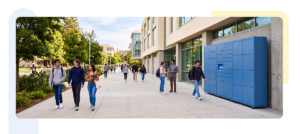
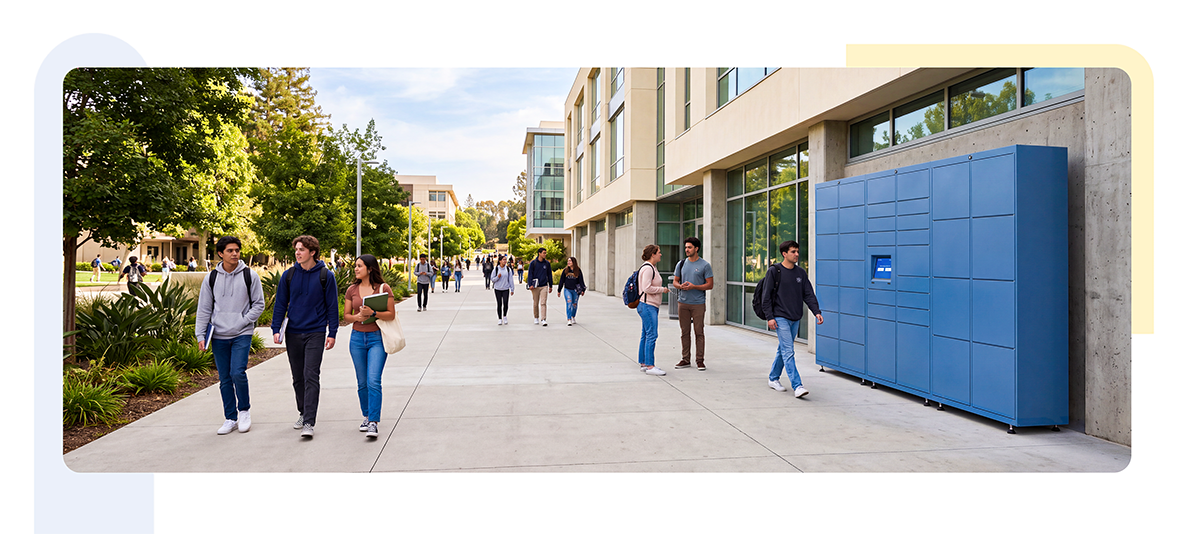
This is where smart lockers for university campuses can make a meaningful difference. Rather than requiring students to collect every package directly from a staffed counter, universities can provide secure, automated collection points where packages can be stored until the student is ready to pick them up.
The process becomes much simpler. A package arrives, it is placed into an assigned locker compartment, and the student receives a notification. When convenient, the student visits the locker, completes the required authentication, collects the package, and leaves.
For a process that happens thousands of times a semester, removing even a few minutes of unnecessary interaction can have a considerable impact.
What Smart Lockers Change for Students
Imagine a student finishing a late afternoon class and receiving a notification that their package is ready. Instead of checking whether the mailroom is still open or waiting in a queue, they can walk to a nearby university smart locker, collect the package, and continue with their day.
That convenience may sound simple, but it is exactly what makes the model valuable.
University life does not operate on a neat nine-to-five schedule. Students attend classes, study late, work part-time jobs, participate in sports and clubs, and move around campus constantly. A package collection system that fits around those routines is naturally more useful than one that asks students to adapt their schedules to it.
Smart parcel lockers for universities can also give students more confidence that their packages are being stored securely. Instead of leaving deliveries in open areas or relying on students to collect them immediately, packages can remain in controlled compartments until the recipient is ready.
Taking Pressure Off University Staff
The benefits are not limited to students.
For mailroom teams, one of the most time-consuming parts of the job can be managing individual collections. Every student interaction takes time, even when the task itself is simple. During peak periods, that can result in long queues and staff spending much of their day locating and handing over packages.
A locker system changes that dynamic. Staff can concentrate on receiving and processing deliveries, while students can complete the final collection themselves.
This does not eliminate the need for university mailroom staff. It changes where their time is spent. Instead of repeatedly handling routine collections, employees can focus on incoming deliveries, exceptions, carrier coordination, inventory, and other tasks that require human attention.
For universities dealing with increasing delivery volumes, this can make package management for higher education considerably more scalable.
The Real Opportunity Is Automation
The most interesting part of a smart locker system is not necessarily the locker itself. It is what happens when the locker becomes part of a connected digital process.
A package can be received and recorded, assigned to a locker, and linked to the student’s information. The student can automatically receive a notification when the package is ready. Once it has been collected, the compartment becomes available for another delivery.
When integrated with existing university systems, these steps can become part of a broader automated workflow. This can reduce manual data entry, improve visibility into package status, and make it easier for staff to understand what has been received, what is waiting for collection, and what remains unclaimed.
The same principle can apply to other types of campus deliveries. Universities may use secure lockers for student mail, internal deliveries, equipment distribution, residence hall supplies, or other items that need to move around campus.
In other words, campus delivery management can become more organized without making the process more complicated for the people using it.
What Happens During the Busy Weeks?
The real test comes when the campus gets busy.
Think about move-in week. Thousands of students arrive within a short period, many carrying luggage while also receiving packages for their rooms. Or consider the beginning of a semester when students order books, electronics, dorm essentials, and everything else they need for the year.
These are the moments when traditional mailrooms can become overwhelmed.
A distributed network of smart lockers can give universities additional collection capacity in locations where students already spend time, such as residence halls or student centers. Instead of forcing every package and every student through one central point, universities can create a more distributed model.
That can help reduce congestion while making collection more convenient.
It also gives universities an opportunity to plan around predictable peaks rather than simply reacting when the mailroom becomes overloaded.
From Mailroom Management to Student Experience
There is a bigger lesson here. Package delivery may sound like a relatively minor campus service, but it sits directly within the everyday student experience.
When a student cannot find their package, waits in a long queue, or discovers that the mailroom has closed five minutes before they arrive, the frustration is not really about the package. It is about friction.
Universities are increasingly looking at these everyday interactions as part of the broader digital campus experience. Students already expect banking, shopping, food delivery, travel, and other services to be convenient and largely self-service. Campus services are being held to the same expectations.
That is why smart lockers for university campuses are becoming more relevant. They bring a familiar self-service experience into a physical campus environment, while giving universities a practical way to manage growing package volumes.
Where University Package Management Is Heading
The future of university package management is unlikely to be about building bigger rooms filled with more shelves. It is more likely to involve smarter processes, better use of space, automation, and secure self-service collection.
Smart lockers are one part of that evolution. They can help universities manage the physical side of an increasingly digital student lifestyle, connecting the moment a package arrives with the moment a student collects it.
The goal is not to make the mailroom disappear. It is to make the entire process work better.
For students, that can mean fewer queues, more flexibility, and a more convenient way to receive the things they order every day. For universities, it can mean less pressure on staff, better use of space, and a more scalable approach to student package delivery.
And perhaps that is the simplest way to look at the package overload problem. The number of packages may keep growing, but the complexity of managing them does not have to grow at the same rate.