

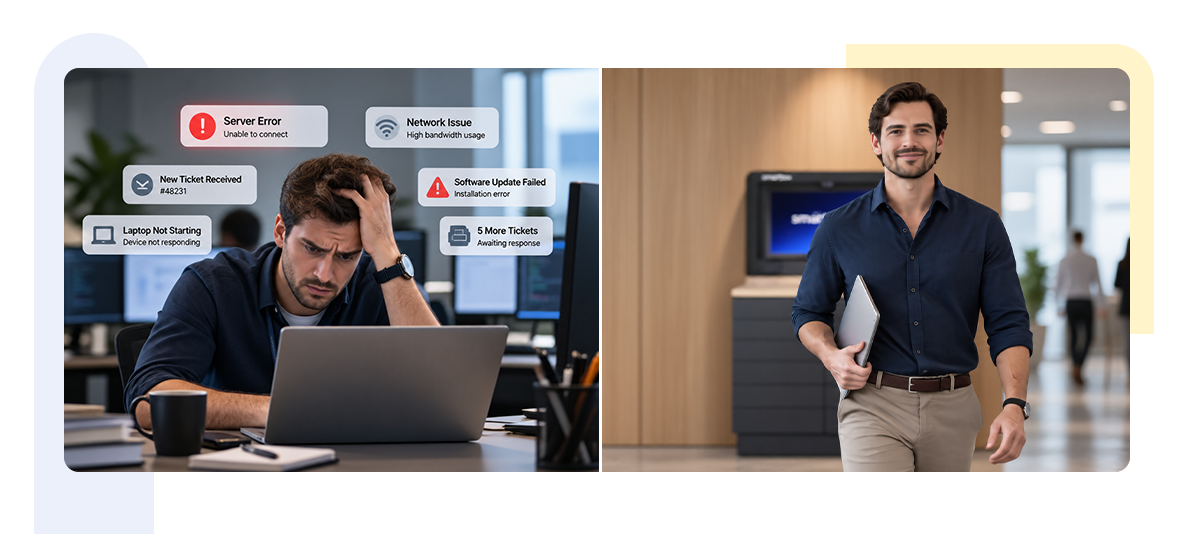

IT support has traditionally been built around the idea of the ticket. Something breaks, someone reports it, a service desk receives the request, and a person works through the steps required to resolve it. The model is familiar because it works. But it is also built around interruption.
The rise of AI is changing that assumption.
Increasingly, IT teams are moving towards an autonomous-first model in which systems can identify problems, understand requests, make decisions, and carry out routine actions with limited human intervention. The aim is not to remove people from IT. It is to give them fewer repetitive tasks and more time for the problems that genuinely require judgement.
This is where IT service desk automation becomes more than automated ticket routing. It becomes part of a broader system of autonomous IT operations, where digital systems and physical infrastructure work together to deliver support.
What does autonomous first IT mean?
Autonomous first IT describes an approach in which technology is designed to handle routine IT processes automatically wherever it is safe and practical to do so.
A conventional service desk might wait for an employee to report that their device is running slowly. A more autonomous environment could detect unusual behavior before the employee notices it, investigates the cause, and potentially take corrective action.
This is the thinking behind self-healing IT.
Machine learning can identify patterns across systems. AIOps platforms can analyze large volumes of operational data. Endpoint management tools can monitor devices and apply predefined actions. AI chatbots can understand employee requests and resolve straightforward issues without requiring a human agent.
The service desk gradually shifts from being the place where every problem begins to becoming the layer that oversees a much larger network of automated processes.
From reactive support to proactive IT
The difference between reactive and proactive support is subtle but important.
Reactive IT waits for a problem to become visible. Proactive IT looks for signals that something may go wrong.
Predictive maintenance is a good example. Instead of waiting for hardware or software to fail, systems can analyze performance data and identify patterns associated with potential failure. IT teams can then intervene before the problem affects an employee.
The same principle applies to security patches, device health, application performance, and capacity planning.
AI in IT support can make these processes more sophisticated by recognizing patterns across large and complex environments. Instead of simply following a fixed rule, machine learning IT operations can help identify relationships that may not be obvious to a human administrator reviewing individual alerts.
The result is a service desk that spends less time responding to yesterday’s problems and more time preventing tomorrow’s.
The changing role of the service desk
AI does not necessarily make the service desk less important. It changes what the service desk is responsible for.
A virtual personal assistant can answer common questions. AI chatbots for IT support can help employees reset passwords, troubleshoot basic problems, check request status, or find relevant information. A GenAI service desk can go further by interpreting natural-language requests and connecting them to the right workflows.
Behind the conversation, however, there needs to be a system capable of actually doing something.
An employee might ask an AI assistant for access to a particular application. The assistant can understand the request, check whether the employee is eligible, initiate approval if required, and trigger automated provisioning once the request is authorized.
That is where smart workflow orchestration becomes essential.
The intelligence sits at the front of the interaction, but orchestration connects that intelligence to the systems and actions required to complete the task.
What is zero-touch fulfillment?
One of the clearest examples of autonomous IT is zero-touch fulfillment.
Imagine an employee joining an organization. Traditionally, onboarding can involve several separate tasks: creating accounts, assigning permissions, preparing a laptop, installing applications, and making sure the employee can physically collect the equipment.
In an autonomous model, much of this process can be triggered by information already held in organizational systems.
Automated provisioning can create the required accounts and permissions. Endpoint management can configure the device. Workflow orchestration can coordinate approvals and dependencies. A service desk platform can keep a record of the process without requiring an IT employee to manually manage every step.
The final physical handover is where technologies such as smart lockers become interesting.
Where smart lockers fit
A smart locker is not an AI system by itself. Its value in an autonomous IT environment comes from what it can connect to.
When integrated through APIs with identity systems, IT service management platforms, endpoint management tools, or other enterprise software, a smart locker can become a physical endpoint in an automated workflow.
An employee could request a laptop through an IT portal or AI assistant. Once the request is approved, the relevant workflow can trigger device preparation and provisioning. When the equipment is ready, the employee can receive instructions to collect it from an assigned locker using an authorized digital credential.
The final interaction still happens in the physical world, but much of the process leading to it can happen automatically.
This is an important distinction. Autonomous IT does not mean that everything becomes digital. It means that digital intelligence can coordinate physical actions with far less manual intervention.
Connecting AI to the physical workplace
The workplace has always contained a physical layer that software alone cannot replace.
Employees need laptops. Devices need to be stored, collected, repaired, replaced, and returned. Hardware sometimes needs to move between locations. New employees need equipment. Departing employees need to return it.
These activities can become bottlenecks if every step requires a person to coordinate the handover.
Smart lockers can provide a controlled physical access point within an otherwise automated workflow. With appropriate API integration, access can be connected to identity and authorization systems, while transactions can be recorded as part of the broader service process.
This makes the locker less like a piece of office furniture and more like a physical interface for IT service delivery.
Ticket auto-resolution and automated workflows
The promise of ticket auto-resolution is not that every IT ticket disappears. Rather, routine requests can be recognized and resolved through predefined or AI-assisted workflows.
A password reset may require no human intervention. A standard software request may trigger automated provisioning. A device health issue may initiate a remediation process through endpoint management. A hardware replacement request may begin a workflow that coordinates approval, provisioning, and physical collection.
Each automated action reduces the number of steps that need to be handled manually.
Over time, organizations can also learn from the process itself. Which requests occur most often? Where do workflows slow down? Which issues repeatedly require human intervention?
These insights can help IT teams redesign services around actual patterns rather than assumptions.
The role of AIOps and machine learning
At larger organizations, the volume of IT data can make manual monitoring increasingly difficult.
AIOps brings together data from infrastructure, applications, endpoints, logs, monitoring tools, and other systems to identify patterns and anomalies. Machine learning can help distinguish meaningful signals from the noise generated by modern IT environments.
This can support proactive IT support by identifying potential problems earlier and helping teams prioritize their response.
For example, several seemingly unrelated alerts might point towards the same underlying issue. An intelligent system can correlate those signals rather than treating each alert as an independent event.
That ability to see the larger pattern is one of the foundations of autonomous IT operations.
Human judgement still matters
There is a temptation to describe autonomous IT as a future where technology simply takes over. That is too simplistic.
Some IT decisions carry security, financial, operational, or organizational consequences that require human judgement. Automation works best when its boundaries are clear.
Routine, repeatable, low-risk processes are strong candidates for automation. Complex incidents, unusual access requests, sensitive security events, and decisions with significant consequences may still require human oversight.
The most useful model is therefore not “AI instead of IT teams.” It is AI with clearly defined authority.
IT professionals remain responsible for designing workflows, setting policies, reviewing exceptions, managing risk, and improving the systems that automation depends upon.
The autonomous workplace is a connected system
The most interesting development in AI-driven IT service delivery is not any single technology. It is the connection between them.
An AI assistant can understand a request. A service management platform can create the appropriate workflow. An identity system can verify the employee. Automated provisioning can prepare the required resources. Endpoint management can configure a device. A smart locker can make that device physically available.
Each component performs a different job.
Together, they create something closer to an autonomous service chain.
That is ultimately where smart lockers fit into the autonomous first IT model. They do not replace the service desk, and they do not make IT operations autonomous on their own. They provide a physical layer through which an increasingly automated service can reach the employee.
The future of IT service delivery may therefore be less about eliminating the service desk and more about changing what happens around it. Intelligent automation can handle predictable processes, AI can make sense of increasingly complex requests, and connected physical infrastructure can complete actions that still need to happen in the real world.
The result is a model in which IT support becomes quieter, faster, and more proactive. Employees spend less time waiting for routine help, while IT teams can spend more of their attention on the work that technology cannot easily automate.
That is the real promise of an autonomous-first workplace: not a workplace without people, but one where technology takes better care of the predictable work so people can focus on meaningful work.