


Think about what residents at your property deal with every time they order something online. A package arrives during work hours, sits in a pile near the front desk, and by the time they get home at 9pm, either nobody is around to hand it over, or they are not even sure if it made it there. That frustration is completely avoidable, and smart multifamily package management is exactly how today’s leading properties are solving it.
This is not just a convenience story. In a market where Gen Z renters have more options and higher expectations than any previous generation, the way your building handles deliveries is now a genuine differentiator. Properties that treat package management as an afterthought are already losing residents to ones that do not.
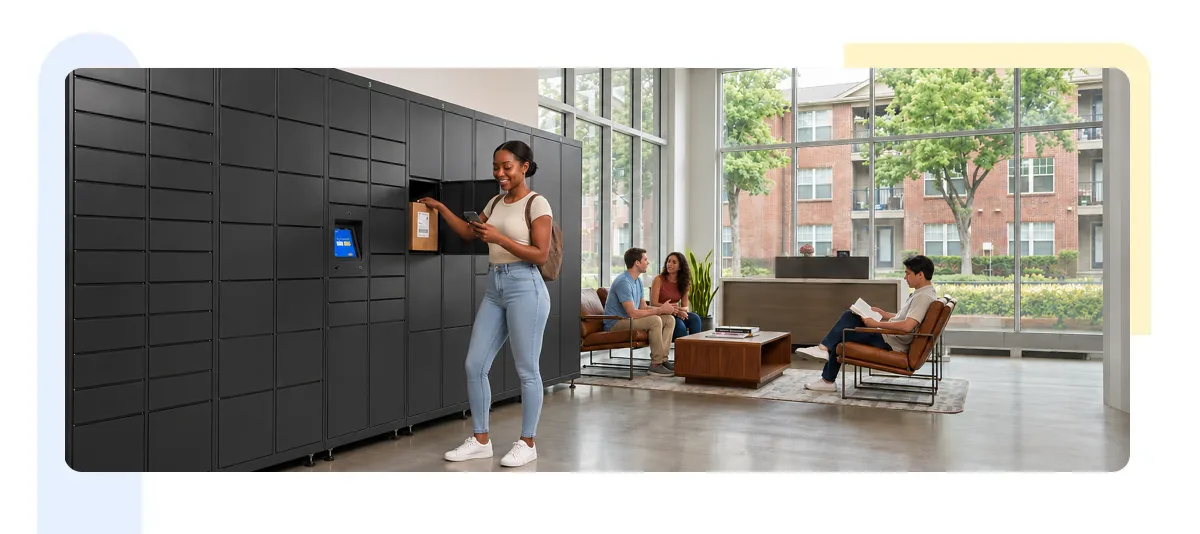
Apartment and multi-family housing package solutions range from staffed parcel rooms to fully automated smart lockers. Intelligent solutions like Smartbox lockers give multifamily properties 24/7 self-service package pickup, cutting the labor cost of staffed parcel rooms while giving residents – including Gen Z renters who expect app-based convenience – a faster, more secure way to retrieve deliveries than a package pile in the leasing office.
The Package Pile-Up Problem Nobody Talks About
The numbers are hard to ignore. Apartment residents receive an average of four parcels per week, and that figure has been climbing every year since 2020. Between grocery deliveries, fashion returns, electronics, and subscription boxes, the mailroom at virtually every multifamily property in the country is under more strain than it was ever designed for.
Package theft in multifamily buildings is not just a resident problem; it is a property reputation problem. A single stolen parcel complaint shared publicly can hit your Google score, trigger lease non-renewals, and directly impact NOI. Over a third of renters have experienced package theft, and properties without active parcel management systems see this reflected in reviews and renewal rates. Properties with smart locker systems in place report significantly fewer theft incidents and far fewer negative reviews tied to deliveries.
The front-desk bottleneck is where most of this frustration concentrates. Staff spend a meaningful chunk of their day logging, storing, and chasing packages. That is time that could be going toward leasing tours, maintenance follow-ups, or actual resident relationship building. And for residents who work standard hours, arriving home to a locked office with their delivery held behind it is a genuinely poor experience.
For property managers trying to improve NOI while cutting operational friction, multifamily package management has quickly become one of the highest-leverage investments available in proptech today.
What Gen Z Renters Actually Want from Package Management
Gen Z is not like previous renter cohorts, and that is not a criticism. It is a design spec. This generation grew up with Amazon Prime, same-day delivery, and app-based everything. They expect their homes to work the same way. So, when a building’s package system runs on sticky notes and a shared spreadsheet, it lands as a dealbreaker rather than a quirk.
According to NMHC package management trend data, amenity preferences among younger renters have shifted decisively toward tech-enabled self-service. Fitness centers and co-working lounges are still important, but logistics infrastructure, specifically reliable and frictionless parcel management, now ranks inside the top five amenity priorities for renters under 30.
What does that look like in practice? Four things come up consistently:
- 24/7 access. Late-night pickups matter. Gen Z renters run on non-traditional schedules and expect to collect deliveries at 11pm without asking anyone’s permission.
- Real-time notifications. A push alert, the moment a parcel lands. No guessing, no calling the front desk, no wasted trips to an empty lobby.
- Individual compartment security. The anxiety of “did someone take it” disappears when every delivery goes into its own locked space rather than a shared pile.
- Zero front-desk queues. Nobody wants to stand in line to pick up a parcel. Self-service collection is not a perk for Gen Z; it is the expectation.
One property manager at a 240-unit urban community put it plainly: “When we added smart lockers, our leasing inquiries from younger renters specifically mentioned it within the first two minutes of a tour. They noticed it, and it mattered to them.”
What Are the Best Package Management Solutions for Apartment Buildings?
There are a few routes property managers typically explore when overhauling their parcel management system for apartments. Here is how they break down in practice.
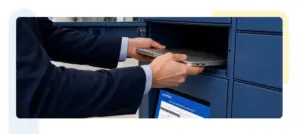
Smart package lockers are the most scalable and operationally lean option. A bank of individually secured electronic compartments installed in your lobby or a dedicated package room. Couriers deposit parcels directly; residents receive an instant notification and access code, and collection happens entirely without staff involvement. These are the current gold standards in multifamily amenity technology.
Package rooms with management software offer a step up from an unmanaged pile but still rely on staff to organize the space and residents to trust a shared environment. This works reasonably well for smaller buildings with predictable delivery volumes, but the cracks show fast at scale.
Carrier-specific services tend to create friction in multi-courier environments. In a high-volume multifamily setting, fragmented solutions generally produce more headaches than they solve.
Concierge-managed delivery works for premium positioning but is not scalable. Staff labor costs make it untenable for most NOI-conscious properties, and the human element reintroduces exactly the failure modes that technology eliminates missed shifts, miscommunication, lost parcels.
Properties using automated parcel management systems consistently report 70%+ reductions in staff time spent on deliveries, alongside measurable improvements in resident satisfaction scores tied specifically to the delivery experience.
Smart Locker vs Package Room: Which Is Better for Multifamily?
This comes constantly in property management forums and NMHC discussions, so it deserves a proper side-by-side.
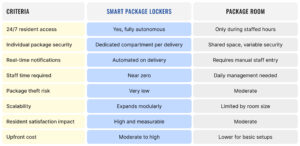
How Do Smart Lockers Improve Resident Satisfaction Scores?
Resident satisfaction in multifamily is a lagging indicator for most of the things that actually drive it. Package delivery is unusual because it is a daily or near-daily touchpoint, meaning it has an outsized influence on how a resident feels about their building.
Smart lockers remove the two primary sources of delivery-related anxiety. A parcel in a locked compartment is a parcel that is safe. Residents stop worrying about porch pirates the moment they receive that confirmed delivery notification. And without access friction, there are no more “I got home at 9pm and the office was closed” conversations.
Beyond that, the downstream effects compound quickly. Staff interactions around lost or delayed packages drop sharply. Fewer complaints, fewer tense lobby conversations, fewer negative reviews tied to deliveries. And the amenity itself signals something to residents. Smart lockers communicate we thought about your life, not just your apartment.
Properties that measure satisfaction at a granular level report that delivery-experience questions shift most dramatically after smart locker installation. Renewal intent improves meaningfully among residents who actively use the system, which in high-delivery demographics means almost everyone. It is one of the faster-moving needles available to a property team without requiring a physical renovation.
Smartbox: Purpose-Built for Modern Multifamily
Among the dedicated parcel management providers operating in the multifamily space, Smartbox stands out for designing its system specifically around the operational realities of apartment buildings rather than retrofitting a warehouse logistics product into a residential context.
What that means in practice is a carrier-agnostic locker system that handles deliveries from every major courier, integrates with existing property management platforms, and gives residents a genuinely frictionless experience from notification to pick up. The management dashboard gives property teams real-time visibility into occupancy, overdue collections, and system health, turning what used to be a daily operational headache into a set-and-monitor workflow.
For properties evaluating proptech package solutions, Smartbox’s modular hardware and software infrastructure makes it a strong fit across building sizes, from boutique mid-rises to large-scale build-to-rent communities. The ability to scale capacity without replacing hardware is particularly valuable for growing developments where delivery volumes are still climbing.
Student Housing and Campus Properties
Student apartment lockers and campus package management present a specific version of the multifamily challenge with the dial turned up. Student housing communities typically see extremely high delivery volumes concentrated in short windows, with a resident population that is among the most digitally native and least tolerant of friction anywhere in the rental market.
A 400-bed student community can receive hundreds of parcels in a single day during peak periods. Attempting to manage that manually is not just inefficient; it is genuinely unrealistic. Package lockers designed for campus environments, with higher-throughput configurations and mobile-first notification systems, have become a standard expectation rather than a premium feature at competitive student housing developments.
For HOA package locker installations, planned communities and condo associations face a similar dynamic. Centralized locker systems dramatically reduce the informal chaos of parcels accumulating in shared lobbies and common areas, which tends to generate its own stream of resident complaints.
One important note for student housing operators: peak delivery periods can be 8 to 12 times the daily volume of off-peak periods. Your package management system needs to be sized for the ceiling, not the average.
The Big Picture
Multifamily package management has moved from back-office operational concern to front-of-house amenity differentiator in the span of about five years. Gen Z renters are not going to lower their expectations around delivery convenience, and parcel volumes flowing into apartment communities will only increase.
Property managers who invest in smart locker infrastructure now are buying a genuine competitive edge, a measurable improvement in resident satisfaction, and a significant reduction in the daily operational drag that comes with managing deliveries manually. That is a rare combination in proptech: a single investment that improves the resident experience and reduces operating costs at the same time.
If your property is still running on the sticky-note-and-spreadsheet system, the question is not really whether to upgrade. It is which smart locker solution fits your building best, and how soon you can get it in before your next lease renewal cycle.