


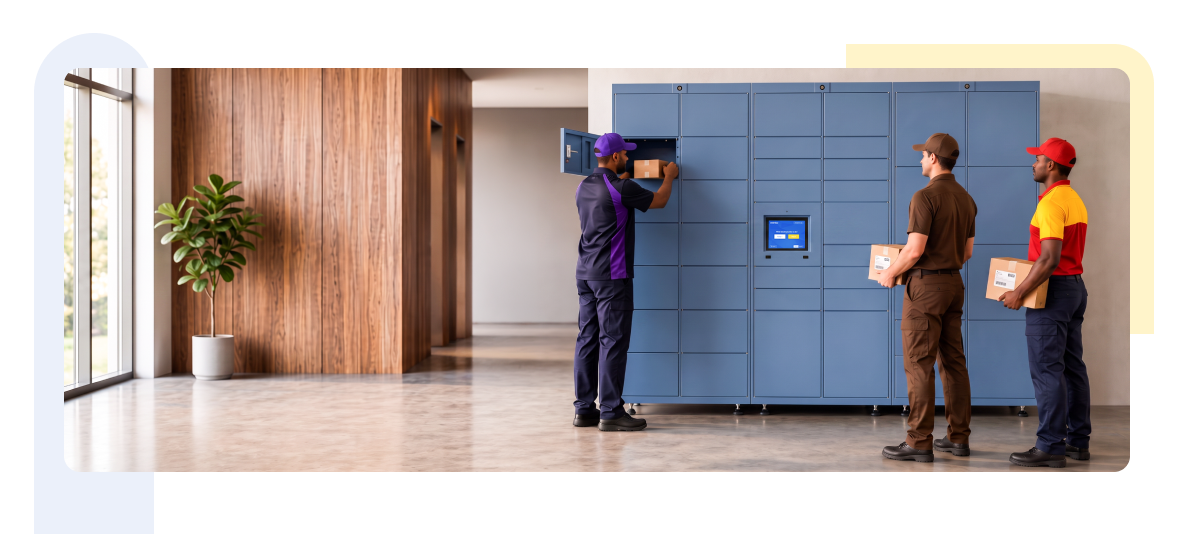

Picture a fairly ordinary week. An order from Amazon arrives on Monday. A pair of shoes from a direct-to-consumer brand ships Wednesday through a regional courier. A gift from a local retailer comes Friday via a different parcel network entirely. In most cities today, that means three different pickup experiences, three different apps, and possibly three different locations to visit if nobody is home to receive them.
Now picture the alternative: every one of those parcels, regardless of which company delivered it, waiting in the same secure locker bank a few steps from the front door. One location. One access code. No coordination required.
That shift, from delivery infrastructure owned by a single carrier to infrastructure shared across many, is quietly becoming one of the more consequential changes in last-mile logistics. It is not a cosmetic upgrade to convenience. It changes who can use a given piece of real estate, how carriers plan routes, and how retailers think about fulfillment cost. Multi-carrier parcel lockers, sometimes called open network lockers, are the physical expression of that change, and the businesses that understand the shift early are the ones setting the terms for everyone else.
What Is a Multi-Carrier or Open Network Locker?
A multi-carrier locker is a bank of secure compartments that any participating carrier, retailer, or delivery service can use to drop off and release parcels, rather than a locker system built and reserved for a single shipping company.
Traditional locker networks were designed around exclusivity. A carrier installed its own units, wired them into its own software, and restricted access to its own drivers and its own customers. That model worked well enough when one company controlled most of the volume in a given market. It breaks down once ecommerce becomes fragmented across dozens of carriers, marketplaces, and regional couriers, each with its own share of a customer’s deliveries.
An open network locker flips the ownership logic. The hardware sits in one place, but the software layer, typically a cloud platform connected through open APIs, manages access permissions for multiple carriers at once. Each carrier authenticates through its own integration, deposits a parcel into an available compartment, and the system notifies the recipient regardless of which company made the delivery. Consumers experience a single, carrier-agnostic touchpoint. Behind that simplicity sits a fair amount of engineering: real-time compartment allocation, carrier-specific API integrations, encrypted access credentials, and reporting that keeps every stakeholder’s data separate even though they share the same physical box.
The practical differences show up quickly once you compare the two models side by side. A single-carrier locker is owned outright by the carrier that installs it, with access restricted to that company’s drivers and customers, and compartments that sit idle whenever that particular carrier’s volume is low. An open network locker, by contrast, is typically managed by a neutral operator or shared platform, with multiple carriers connecting through API integrations rather than owning the hardware themselves. That pooled demand tends to produce meaningfully higher utilization, since compartments are filled by whichever carrier has a parcel ready rather than sitting empty between one company’s delivery runs. Consumers feel the difference most directly: a separate app and PIN for every carrier gives way to a single pickup location that works no matter who delivered the order, and a building or district can serve its entire population from one footprint instead of hosting a separate installation for each carrier.
Why the Logistics Industry Is Moving Toward Interoperability
The economics of last-mile delivery have gotten harder to ignore. Last-mile delivery now represents roughly 53% of total shipping cost, up from around 41% in 2018, according to industry data cited by DHL’s Logistics Trend Radar and corroborated by multiple supply chain research firms. That single figure explains a lot of the urgency behind locker investment: it is the most expensive part of the journey and the part with the most room for improvement.
Failed delivery attempts compound the problem. Research published in supply chain journals puts first-attempt failure rates in the range of 8 to 12%, with each failed attempt adding meaningful re-delivery cost. In the UK alone, failed home deliveries have been estimated to cost over a billion dollars annually. Consolidating parcels into a locker that is available around the clock removes the “nobody was home” problem almost entirely, which is one reason McKinsey has pointed to out-of-home delivery, encompassing lockers and pickup points, as a growing lever for operational efficiency in dense urban markets.
Consumer behavior is moving in the same direction independently of what carriers want. Geopost’s 2025 E-Shopper Barometer, one of the widest annual surveys of European online shoppers, found that 46% of regular shoppers now favor out-of-home delivery options, a 15-point jump since 2019. That is not a niche preference anymore; it is close to half the market.
Sustainability pressure adds another layer. Peer-reviewed research on parcel locker adoption has found that shifting home deliveries to locker pickup can cut last-mile CO2 emissions by up to 30% and reduce total delivery traffic by 10 to 25%, largely because consolidated stops replace repeated van trips to individual doors. The World Economic Forum has similarly flagged that unmanaged growth in last-mile deliveries could push urban delivery emissions up substantially by 2030, while locker-based consolidation is one of the few interventions with quantifiable downward pressure on that curve.
Then there is the real estate constraint that rarely gets discussed openly: a building, a retail forecourt, or a transit hub only has so much curb space and so much lobby space. Installing five separate carrier-branded locker walls in the same apartment complex is not just wasteful, it is often physically impossible. Shared infrastructure is frequently the only infrastructure that fits.
How Open Network Lockers Benefit Every Stakeholder
Carriers
Carriers gain fewer failed deliveries and fewer redundant delivery attempts, since a locker accepts a parcel whether or not the recipient is home. This supports better route optimization, because drivers can batch locker drop-offs instead of threading through neighborhoods for single-address stops. The net effect for many carriers is a measurable reduction in per-parcel operational cost, without needing to build and maintain proprietary locker real estate in every location they serve.
Retailers
For retailers, an open network locker acts as a low-friction click-and-collect channel that does not require a storefront. Customers get faster access to online orders, fulfillment costs drop compared with home delivery, and customer service teams field far fewer “where is my order” and missed-delivery complaints, and physical retail locations that host lockers often see incremental foot traffic from people stopping to collect a parcel. Returns get easier too, since the same locker can typically accept a return parcel without a trip to a post office or courier depot.
Property Owners
Residential and commercial property owners deal with a different pain point: overflowing mailrooms, packages piled in lobbies, and residents frustrated by missing deliveries. A shared locker bank absorbs parcel volume from every carrier a resident might order from, which keeps mailrooms clear, reduces staff time spent managing package logs, removes the need to manage multiple carrier-specific systems, and generally improves resident satisfaction scores without requiring the property to pick a single preferred carrier.
Consumers
For the person actually receiving the parcel, the benefit is straightforward: one location, 24/7 access, and a level of physical security that a doorstep or mailroom cannot match. It does not matter which carrier delivered the order. It arrives at the same bank of lockers as everything else, which quietly removes a surprising amount of daily friction from modern online shopping.
Where Open Network Locker Models Are Already Succeeding
Europe offers the clearest evidence that this model works at scale. Poland has become the reference market, with roughly 1.08 lockers per 1,000 people by 2023, the highest density on the continent, and lockers have become the preferred delivery method for many Polish shoppers rather than a fallback option. InPost, the dominant operator there, delivered over a billion parcels in 2024 and continues to expand its out-of-home footprint across the UK and Eurozone, growing volumes well ahead of underlying ecommerce growth in several of those markets.
The Nordics are close behind. Sweden’s locker density nearly matches Poland’s, and in Finland lockers are reportedly the most popular delivery method nationally, with well over 150,000 individual locker doors installed across the country. Germany’s DHL Packstation network, one of the original parcel locker pioneers, continues expanding toward more than 15,000 stations, though newer entrants and carrier-agnostic platforms are beginning to chip into a market that was historically dominated by a single operator.
What is notable is the direction of travel: markets that started with single-carrier dominance are increasingly seeing cross-network access agreements. Interoperability between previously closed networks, such as arrangements allowing one operator’s lockers to accept parcels from a competing carrier, has started appearing in Poland and is being watched closely elsewhere in Europe as a signal of where the model is heading.
The UK, Australia, and Singapore are each following variations of the same pattern: dense urban populations, high ecommerce penetration, and limited available real estate for dedicated single-carrier infrastructure, all of which push naturally toward shared locker ecosystems rather than fragmented ones. Geopost’s parent network, for context, now operates more than 140,000 out-of-home points across Europe, with 94% of the European population living within ten minutes of a pickup point, a scale that would be far harder to reach if every carrier insisted on building its own separate footprint.
Shared networks also let operators place locker locations where demand actually is, such as transit hubs, apartment lobbies and retail forecourts, rather than wherever a single carrier happens to have space.
What Businesses Should Evaluate Before Joining a Shared Locker Network
Choosing a locker partner is less about the box on the wall and more about the software and commercial terms behind it. Decision-makers evaluating vendors should look closely at:
- API flexibility – how easily new carriers, marketplaces, or internal systems can be integrated without custom development for each one
- Scalability – whether the platform supports adding compartments, sites, or entire regions without a redesign
- Security and data privacy – encryption standards, access logging, and how carrier-specific data is segmented within a shared system
- Uptime and reliability – SLA commitments, since a locker that is offline defeats the purpose of 24/7 access
- User experience – how simple the pickup and drop-off flow is for a first-time user, not just a frequent one
- Reporting and analytics – visibility into utilization rates, dwell time, and carrier-level volume
- Maintenance model – whether the vendor or the site owner is responsible for hardware upkeep
- Support and customer service – who handles a stuck compartment or a lost access code, and how quickly the vendor’s customer service team responds when a locker is down
- Carrier onboarding process – how quickly a new logistics partner can be added to an existing installation
- Modular expansion – whether additional locker banks can be added at the same site as volume grows
- Ownership structure – whether the property, the vendor, or a consortium of carriers owns the underlying asset and governs access rules
Getting these details wrong tends to surface months later, when a business realizes its locker software cannot onboard a new carrier without a lengthy integration project, or that a growing site cannot add capacity without ripping out the existing installation.
Single-Brand Lockers vs Open Network Lockers
Carrier support is the clearest dividing line: a single-brand locker serves one carrier only, while an open network locker connects multiple carriers through a shared API layer. That difference cascades into scalability, since a single-brand installation is capped by that one carrier’s growth, whereas an open network scales with total ecommerce demand across every carrier that joins it. Utilization follows the same pattern, with single-brand units often sitting underused outside that carrier’s peak periods and open network units benefiting from pooled demand across several companies at once. Customers dealing with a single-brand locker still need separate apps or locations for whichever other carriers they order from, while an open network gives them one location regardless of who delivered the parcel. Operationally, redundant infrastructure across competing single-carrier installations gets replaced by shared infrastructure that lowers cost per parcel, and the ecosystem itself becomes more adaptable, since new carriers and services can be added without waiting on a single provider’s roadmap. Implementation complexity runs in the opposite direction: a single-brand locker is simpler to set up initially but harder to expand later, while an open network takes more upfront coordination and scales far more easily afterward. The long-term return on investment reflects all of this, capped by one carrier’s volume in the single-brand model and compounding as more carriers and use cases join an open network.
Why Open Networks Represent the Future of Last-Mile Infrastructure
Parcel lockers are increasingly being designed as one node in a larger web of last-mile network infrastructure rather than a standalone convenience. Micro-fulfillment centers are being sited near residential density, and lockers are a natural handoff point between a micro-fulfillment order and a consumer who cannot receive it at home during business hours. Autonomous delivery robots and drones, still early in most markets, need a predictable, secure drop point rather than a doorstep, and an open network locker is a far more practical target than a random front porch.
Electric delivery fleets add another argument for consolidation. Shorter routes with fewer individual stops suit the range and charging constraints of EV vans better than sprawling door-to-door routes, and locker consolidation is one of the more direct ways to shrink a route without cutting delivery volume.
Retailers pursuing omnichannel strategies, meanwhile, need pickup infrastructure that does not care which fulfillment path a given order took. A parcel picked from a store, a distribution center, or a third-party marketplace should be able to land in the same locker. That only works if the locker network itself is carrier-agnostic and platform-neutral from the start, rather than retrofitted later.
Where This Leaves the Industry
None of this suggests single-carrier lockers disappear overnight. Large operators with entrenched networks will keep serving their existing customer base for years. But the direction of investment, from cross-network access agreements in Poland to the API-first architecture increasingly demanded by retailers, points toward infrastructure built for sharing rather than exclusivity.
As parcel volumes keep climbing and real estate for last-mile infrastructure stays limited, the more durable investment is the one that works for the next carrier a business signs with, not just the current one. Smartbox builds smart locker systems designed around that principle: open APIs, modular hardware that supports legacy and next-generation deployments, and software built to onboard new carriers and use cases as networks evolve rather than requiring a rebuild each time.
Frequently Asked Questions
What is a multi-carrier smart locker?
A secure, automated locker that accepts and releases parcels from multiple delivery companies through one shared software platform, so any carrier's driver can use the same locker bank.
How do multi-carrier lockers work?
The software layer is separate from the hardware. Each carrier connects via its own API, and the system assigns compartments and access codes dynamically as parcels arrive - no dedicated hardware per carrier needed.
Can different couriers really use the same locker?
Yes, as long as the locker runs on an open, API-based platform built for multi-carrier access rather than proprietary single-carrier software.
How can I find a parcel locker nearby?
Is this locker model common outside the US?
Yes — Europe and parts of Asia-Pacific are ahead of the US. Poland has Europe's highest locker density, and the Nordics, Germany, UK, Singapore, and Australia have all built out significant shared locker networks.
What are the benefits for businesses?
One piece of infrastructure serving every carrier - lower per-parcel costs, fewer failed deliveries, better space utilization, and no lock-in to a single provider's pricing or roadmap.
Are multi-carrier lockers harder to manage?
Setup takes more coordination upfront (multiple API integrations, access rules, data segmentation). Once running, it's simpler: instead of having to manage multiple single-carrier installations, each with its own app, dashboard, and vendor, operators get one dashboard and one support relationship.