



The modern workplace has learned to live in the cloud, but much of its technology still belongs to the physical world. Laptops are delivered across cities, exchanged between employees, collected after people leave, sent away for repair and, eventually, retired. Behind every apparently seamless digital workplace is a quiet chain of physical movements, and each movement has an environmental cost.
This is why sustainable IT asset management is beginning to mean more than choosing energy-efficient devices or purchasing equipment from suppliers with greener credentials. It asks a more fundamental question: what happens to technology throughout its life? A laptop that is repaired instead of replaced, returned instead of forgotten, or refurbished instead of discarded represents a different kind of IT economy, one in which value is preserved rather than continually recreated through new consumption.
The idea is closely aligned with the principles of the circular economy IT model. The Ellen MacArthur Foundation describes a circular economy as one in which products and materials are kept “in circulation at their highest value.” That principle has an especially interesting application to workplace technology. The most sustainable device may not be the newest one. It may simply be the one that continues to be useful.
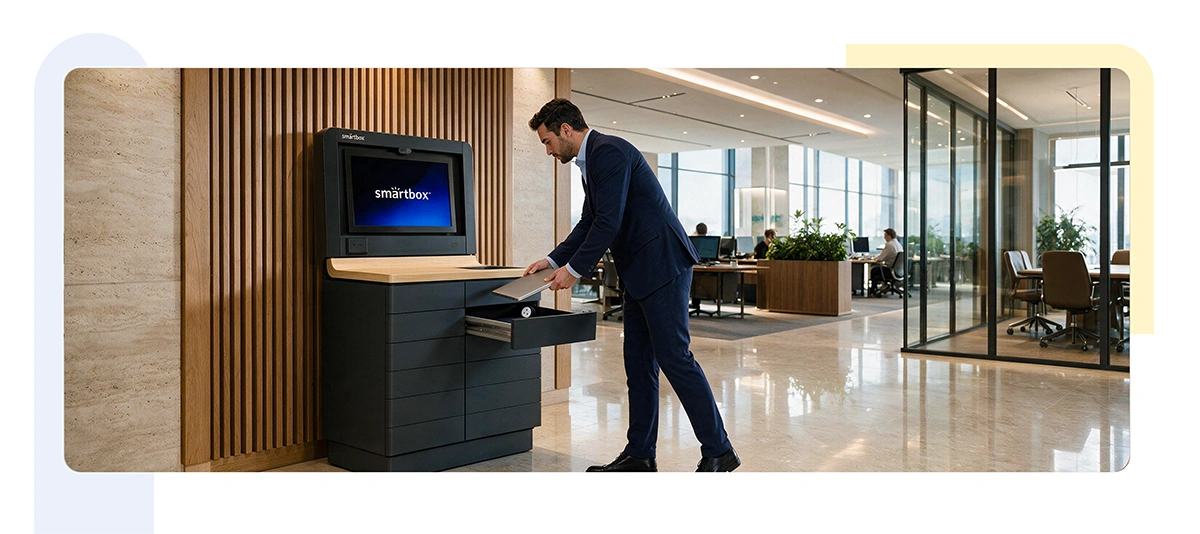
Smart lockers can become part of that infrastructure. They do not, by themselves, make an organization sustainable. What they can do is make certain sustainable behaviors easier to practice at scale: returning a laptop, collecting a replacement, sending equipment for repair or moving a device back into the organization’s inventory. In a distributed workplace, physical convenience can have surprisingly important consequences for the environmental footprint of IT.
Why Sustainability Is Now a Digital Workplace Buying Criterion
Sustainability has gradually moved from the margins of technology strategy into the language of procurement, risk and corporate governance. IT leaders are no longer looking only at whether a device performs well or whether a service can be delivered efficiently. They are increasingly being asked how technology was produced, how long it will remain useful, what happens when it is returned, and how much waste is created along the way.
The scale of the problem makes this shift difficult to ignore. The Global E-waste Monitor estimated that the world generated 62 million tonnes of electronic waste in 2022, with only a little more than one-fifth formally collected and recycled in an environmentally sound manner. The number is striking, but perhaps more revealing is what it says about our relationship with technology: we have become extraordinarily good at producing and replacing devices, and considerably less successful at keeping their value in circulation.
For organizations pursuing an ESG digital workplace strategy, this creates a larger question about the lifecycle of workplace technology. Sustainable procurement matters, but procurement is only the beginning. The environmental story continues through deployment, support, repair, transportation, recovery, and disposal. A green workplace therefore cannot be built solely through what an organization buys. It must also be shaped by what it does with what it already owns.
This is where green IT support begins to acquire a broader meaning. It is not simply about solving a technical problem with fewer resources. It is about designing support operations that avoid unnecessary journeys, preserve useful equipment, and make responsible recovery part of everyday work rather than an exceptional process.
Four Ways Lockers Reduce Environmental Impact
Fewer Technician Dispatches, Lower Scope 3 Emissions
Some of the environmental costs of IT support are easy to overlook because they never appear on an IT invoice. Consider a technician traveling across a city to replace a laptop that could have been collected by an employee from a secure location. The journey may be operationally small, but repeated hundreds or thousands of times; such journeys become part of the physical footprint of the digital workplace.
Smart lockers offer another possibility. A replacement device can be placed securely at a convenient location, allowing an employee to collect it without waiting for a technician to arrive. A faulty device can then make the return journey through the same infrastructure. The value here is not that a locker magically eliminates emissions, but that it can remove some of the physical journeys that traditional IT support requires.
This becomes relevant when organizations examine Scope 3 emissions. The GHG Protocol’s framework recognizes a wide range of indirect emissions across an organization’s value chain, including transportation, distribution, business travel and waste. IT support rarely appears in sustainability conversations as prominently as manufacturing or data centers, yet its physical activities can form part of this wider picture.
The more useful question, therefore, is not whether a locker is “green”, but whether it changes the number and nature of journeys required to keep people equipped to work.
Device Reuse, Repair, and Remanufacturing Loops
There is a peculiar irony in modern technology: a device can become “old” long before it becomes useless. A laptop may no longer belong to one employee yet still have years of productive life ahead of it. What determines its fate is often less the physical condition of the machine than the efficiency of the system around it.
A circular IT model tries to preserve that remaining value. Instead of allowing returned equipment to disappear into storage or moving immediately towards replacement, organizations can create pathways through which devices are assessed, repaired, refurbished, and returned to use.
Smart lockers can support these pathways by providing a dependable point of return and exchange. An employee does not need to arrange a special collection simply to return equipment. A refurbished laptop can be made available where it is needed. A device awaiting repair can move back into the IT workflow without requiring another round of coordination.
This is where device reuse and remanufacturing become more than sustainability terminology. They become operational choices. A repaired device represents avoided production. A refurbished device represents an extension of the resources already invested in it. A component reused elsewhere represents material that does not need to be extracted and manufactured again.
The principle is simple, although its implications are considerable: before asking what new technology an organization needs, it is worth asking what existing technology still has something left to give.
Higher Return Rates, Less E-Waste and Shrinkage
A device cannot be repaired, reused, or responsibly recycled if it never comes back.
This is one of the quieter challenges of IT asset management. Equipment can remain in homes after an employee changes roles, sit in drawers after an upgrade or simply become difficult to recover once a distributed workforce no longer shares a physical office. The asset may still exist, but from the perspective of the organizations circular IT process, it has effectively disappeared.
A secure return point changes that equation by making recovery easier. Instead of arranging a courier or waiting for an IT team member to collect equipment, an employee can return a laptop or peripheral when it is convenient. That small reduction in friction can help organizations improve asset recovery and, in turn, create more opportunities for device refurbishment, redeployment and responsible IT asset disposition (ITAD).
This matters in the context of e-waste reduction. The World Health Organization describes e-waste as one of the world’s fastest-growing waste streams, while also highlighting the environmental and health concerns associated with its improper handling.
The sustainability benefit therefore begins well before recycling. It begins with knowing where equipment is, recovering it when it is no longer needed and determining whether it can continue serving a purpose.
Consolidated Deliveries and Reverse Logistics
The environmental footprint of IT is also shaped by movement. One laptop traveling individually across a city is a different logistical proposition from several devices moving through a planned network of collection and distribution points.
Smart lockers can provide those points. They can sit between employees and the wider IT supply chain, receiving new equipment, holding replacement devices, and collecting equipment that is moving back towards repair, refurbishment or ITAD. In this sense, the locker becomes less interesting as a piece of hardware and more interesting as a point in a reverse logistics system.
That distinction matters. Simply installing lockers does not guarantee carbon footprint reduction. The benefit depends on what organizations do with the network: whether deliveries can be consolidated, whether unnecessary trips are avoided, whether returned devices are efficiently routed and whether the physical movement of technology becomes more predictable.
For organizations working towards a net-zero workplace, these details matter because sustainability is rarely achieved through one dramatic intervention. More often, it emerges from the accumulation of smaller operational improvements.
Measuring It: Carbon per Ticket and Circularity Metrics
What cannot be measured easily tends to remain anecdotal, and sustainability initiatives are particularly vulnerable to this problem. A locker network may appear environmentally beneficial, but an organization needs evidence to understand whether it is actually changing the footprint of IT operations.
One useful place to begin is with the physical intensity of support. How many technician dispatches are required for routine device exchanges? How many can be avoided? How far do those technicians travel? How many devices are recovered after an employee leaves? How many are repaired, refurbished or redeployed rather than replaced?
These questions can gradually form a carbon scorecard for IT support. Carbon per ticket can provide one view of the emissions associated with physical support activity, while device recovery and reuse rates reveal how effectively an organization is keeping equipment within circulation. Lifecycle extensions can show how long devices remain useful, while ITAD data can provide visibility into what happens when that useful life finally ends.
The important thing is not to turn sustainability into another dashboard full of impressive numbers. The purpose of measurement is to reveal where the system can improve. If fewer technicians need to travel, if more devices come back, if more equipment is repaired and if fewer assets are prematurely discarded, then the organization has evidence that its IT operating model is becoming more circular.
This also makes ESG reporting more meaningful. Rather than describing sustainability through broad commitments alone, IT leaders can begin connecting environmental objectives to ordinary mechanics of the digital workplace.
Final Thought
The environmental story of technology is often told at the extremes: the energy consumed by enormous data centers, the minerals required to manufacture new devices, or the growing mountain of electronic waste at the end of their lives. Yet there is another story between these points, and it takes place in the everyday movement of equipment.
A laptop being collected rather than abandoned. A faulty device being repaired rather than replaced. A refurbished machine is being issued to another employee. Several deliveries being consolidated rather than sent separately. None of these acts is dramatic. Together, however, they begin to describe a different way of managing technology.
Smart lockers can support that change by giving organizations a physical infrastructure for more deliberate movement, recovery and reuse. Their importance lies not in the locker itself, but in the behavior and operating model it enables.
The future of sustainable IT asset management may therefore depend less on continually finding a greener version of everything we use and more on learning to use what we already have with greater intelligence.
The most sustainable digital workplace is not necessarily the one with the newest technology.
It may be the one that knows how to keep its technology useful for longer.
FAQs
What is sustainable IT asset management?
How can smart lockers support an ESG digital workplace?
Do smart lockers reduce Scope 3 emissions?
How do smart lockers support circular IT?
What should organizations measure when implementing sustainable IT practices?