



A broken device rarely breaks at the most convenient time.
It happens when a store is busy. When a warehouse is moving at full speed. When a branch is operating with a skeleton team. When the technician who knows the system best is somewhere else. The actual fix may be simple.
Getting the fix there is often not.
For years, that physical gap has been absorbed by field service teams and IT depots. A central depot stores the equipment. A service desk raises the ticket. A technician is dispatched. Spare parts move from one place to another. Someone waits.
It is a model that has served businesses well. But businesses have changed.
IT is no longer concentrated in a handful of offices. It now sits across stores, warehouses, branches, factories, hotels, healthcare facilities and other locations where people need technology to work without thinking about it.
The more distributed the business becomes, the more expensive distance becomes.
That is why the conversation around IT depot services is beginning to move beyond storage and dispatch. The question is becoming more fundamental:
What if the depot did not always have to be somewhere else?
The real problem with the traditional depot model
A depot is useful because it gives IT equipment a place to wait.
Replacement laptops, scanners, printers, networking equipment, cables, accessories and other break-fix inventory can be stored, repaired, configured and prepared for deployment.
The difficulty begins when the equipment is needed far away.
Imagine a device failing at a branch several hours from the nearest IT depot.
The service desk diagnoses the problem. A replacement is available. A technician is assigned.
But the replacement still has to travel.
Perhaps the technician collects it from the depot. Perhaps it is shipped to the location. Perhaps the technician arrives first and discovers that another component is required.
A relatively small hardware failure can suddenly involve inventory coordination, courier movement, scheduling, travel, and another visit. The cost is not just the replacement device.
It is the distance around it. This is where technician dispatch cost, response time and first-time fix rate begin to matter.
Field service was built around the technician
Traditional field service is, at its heart, a people-led model. Something goes wrong. Someone goes there.
A technician provides the expertise that cannot always be delivered remotely. They inspect the equipment, replace a component, configure a device or solve the problem that a service desk cannot resolve from behind a screen.
That work is important. But the model becomes harder to sustain when the number of sites grows.
A company with ten locations can absorb a certain amount of travel. A company with 500 locations has a different problem.
Every unnecessary journey becomes part of the operating model.
This is why field services modernization is not simply about giving technicians better software or better scheduling tools. Those things matter, but they address only part of the equation.
The physical side of service delivery deserves the same attention.
Where is the equipment?
Who can access it?
How far does it have to travel?
And does a technician really need to carry it all the way from the depot?
Moving inventory closer to the work
Logistics has understood the value of proximity for a long time.
When demand is predictable, inventory is often placed closer to where it will be needed. In IT operations, this idea is sometimes described as a forward stocking location.
The principle is simple. You do not necessarily move everything closer.
You move the things that are most likely to be needed.
For a distributed IT environment, that could mean positioning frequently requires replacement devices and spare parts closer to branches, warehouses, or remote sites. But there is an obvious challenge.
A forward stocking location does not need to become another staffed depot.
Most organizations cannot justify an IT employee sitting at every location simply to hand over a replacement laptop at 10:30 on a Tuesday morning.
This is where the idea of an unmanned IT depot becomes interesting.
The rise of the unmanned IT depot
An unmanned IT depot is not a warehouse without people. It is a different way of thinking about access.
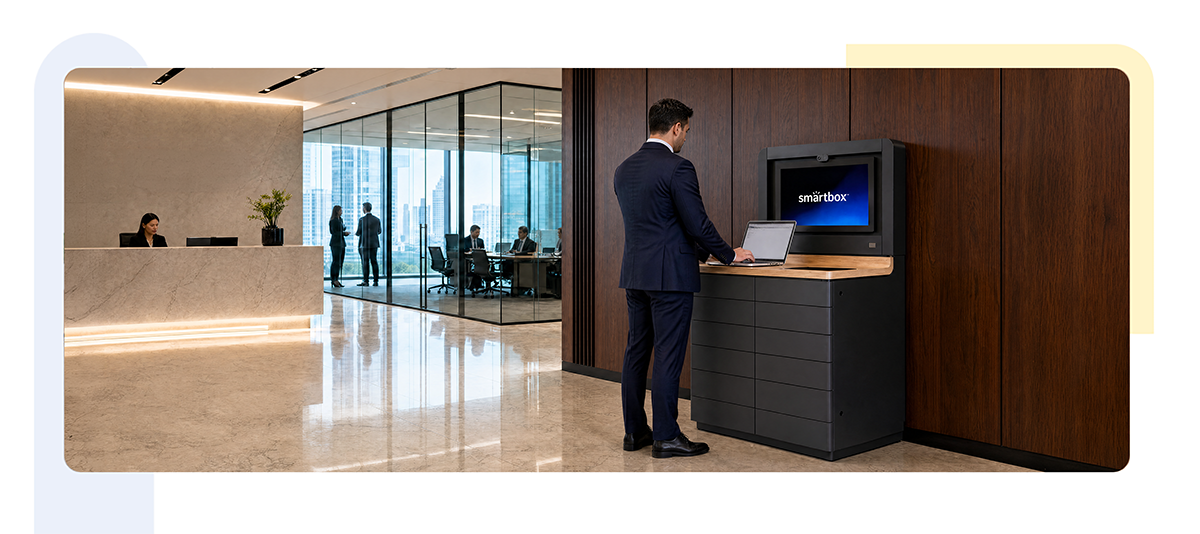
A secure smart locker can hold IT equipment at a location without requiring that location to have a permanently staffed service desk or storage room. An authorized technician can collect a replacement device.
A frontline worker can retrieve equipment when required.
A faulty device can be returned.
The central IT or logistics team can still manage the larger inventory operation, while the physical point of exchange sits closer to the people using the technology.
The locker becomes a quiet piece of infrastructure. It does not diagnose the problem. It does not replace the technician.
It simply makes sure that when the solution is a physical object, that object does not have to begin its journey from the other side of the map.
Remote support can solve only so much
Modern IT teams have become remarkably good at supporting people from a distance.
A service desk can identify an issue without entering a building. Monitoring systems can detect failures. Remote access can resolve configuration problems. Software can be deployed without anyone touching the device.
But hardware has a stubborn relationship with geography. The broken scanner is still broken.
A failed laptop still needs another laptop.
A damaged network component still needs physical replacement. This is why remote site IT support cannot be separated entirely from physical logistics. The digital part of support may be remote. The replacement often is not.
For teams managing remote site support, the challenge is therefore not only how to diagnose problems remotely. It is how to make the physical response just as intelligent.
A smart locker can become part of that response.
From technician dispatch to smarter service coverage
Consider what happens when a replacement device is already waiting near the site.
The service desk identifies the issue. The required device is located in a nearby smart locker. An authorized person collects it. The faulty device can be returned through the same service point.
The technician can still be involved when technical expertise is needed. But the technician no longer has to be the person who physically transports every piece of equipment.
That distinction may sound small.
Operationally, it is not.
For businesses with large branch networks, it can change how branch IT support is organised.
For warehouses, it can mean less disruption to frontline operations.
For a deskless workforce, it can mean access to replacement equipment without waiting for someone from another location to arrive.
And for field teams, it can mean spending less time travelling simply to deliver hardware.
The first-time fix starts before the technician arrives
There is a useful way to think about the first-time fix rate. It is not only determined by what the technician knows. It is also influenced by what the technician has access to.
A skilled technician arriving without the right replacement part cannot complete the job.
That creates the familiar cycle:
Diagnose. Travel. Discover. Wait. Return. Fix.
The smarter version is:
Diagnose. Access. Replace. Resolve.
The difference is often inventory positioning. This is where spare parts management becomes part of the field service conversation.
A replacement sitting in a central depot may count as available in inventory. But from the perspective of a branch three hours away, it may as well be somewhere else entirely.
Availability is not just about whether something exists. It is about whether it is reachable when it is needed.
A new role for IT logistics
This changes the role of IT logistics too.
Instead of thinking about inventory as something that moves outward from one central location, organizations can begin to think about it as a network.
The central depot remains important. It can continue to handle bulk inventory, repairs, refurbishment, configuration, and replenishment.
But smaller inventory points can extend its reach. Smart lockers can serve as unattended service points, positioned according to demand.
A high-volume retail cluster might need a different inventory strategy from a remote manufacturing facility.
A warehouse may need scanners and handheld devices.
A branch network may need laptops, printers, or networking equipment.
The principle is not to put everything everywhere.
It is to understand what tends to fail, where it fails, and how quickly it needs to be replaced.
Then place the right inventory accordingly.
Where the smart locker depot model makes sense
The model is particularly relevant to organizations where three things come together:
A large number of physical locations.
A recurring need for IT equipment or spare parts.
And a meaningful cost associated with sending people or equipment between those locations.
Retail is an obvious example.
A retailer may have hundreds of stores, each relying on devices that support everyday operations. A small hardware failure should not require a long logistical chain if the replacement can safely wait nearby.
Warehousing and logistics present another strong use case. Technology is embedded in the movement of goods, and equipment failures can interrupt the work of an entire site.
Manufacturing, hospitality, healthcare, and distributed corporate environments face similar questions, even when the equipment and workflows are different.
The common thread is not the industry.
It is distance.
Modernizing the depot means rethinking the word “depot”
Perhaps the most interesting part of this shift is that the depot itself does not disappear.
It changes the shape. For decades, a depot was understood as a physical place. One building. One inventory. One location from which equipment moved outward.
A modern IT depot can be thought differently. It can be a connected network of physical access points, supported by a central operation. The central depot still exists.
But its reach extends through smaller, secure locations closer to demand.
That creates a model in which inventory can be centralized where it makes sense and distributed where proximity creates value.
It is a subtle change.
But many operational transformations begin with subtle changes in where things sit.
The future of field and depot services may be closer than we think
The future of IT support will not eliminate technicians. Nor will it eliminate depots.
It may simply ask them to do what they are best at. Let the technician solve the problem that requires expertise. Let the central depot manage the inventory that benefits from centralization.
And let secure, distributed service points take care of the distance between. That is the promise of the smart locker depot model.
It brings physical IT support closer to the people who depend on it without requiring every location to become a staffed IT facility.
For organizations thinking seriously about field services modernization, that is a useful distinction. Because sometimes the fastest way to improve a service is not to make the journey faster. It is to make the journey shorter.
And sometimes, the best place for an IT depot is not where the equipment has always been.
It is closer to where the next problem is likely to happen.