


Introduction
Walk into almost any coworking space or modern office today, and you’ll find fiber-speed Wi-Fi, ergonomic chairs, cold brew on tap, and standing desks as far as the eye can see. Operators have poured investment into every amenity imaginable. Except two: somewhere to put people’s packages, and somewhere to put their stuff.
That is why teams searching for the best office employee lockers 2026 has to offer – and for the best smart locker system for offices and flexible workspaces – are looking at the same category of product. Package management and employee storage are now solved by one piece of infrastructure, not two.
Every day, hundreds of members across a typical coworking campus receive deliveries: laptops, client samples, equipment, office supplies, and personal parcels. And every day, those packages pile up at the front desk, clog the reception counter, and quietly eat away at staff time, member trust, and operator revenue.
In 2026, smart lockers have become table stakes for apartment buildings and university campuses. But the coworking industry, a sector valued at over $22 billion globally and growing at a 14% CAGR through 2035, has largely been left out of the conversation.
That gap is both a problem and an opportunity. Smartbox was built to close it.
This guide breaks down why smart lockers are the single most overlooked amenity in coworking spaces right now, what operators stand to gain, and how to evaluate the right solution for your space.
The Coworking Boom Has a Package Problem
The numbers tell a clear story. As of Q3 2025, the United States alone had 8,420 coworking locations covering over 152 million square feet of flexible workspace. Globally, there are roughly 42,000 coworking spaces serving a rapidly expanding mix of freelancers, remote workers, startups, and enterprise teams.
And those members shop online constantly.
A modern professional receives an average of 3 to 5 packages per week. In a mid-sized coworking space with 200 active members, that translates to hundreds of inbound deliveries every single week. Unlike apartment buildings, coworking spaces typically have no dedicated package infrastructure, no back-of-house mailroom, and no protocol beyond “leave it at the front desk.”
The result is chaos that most operators have quietly learned to live with:
- Reception desks buried under uncollected packages
- Staff spending hours logging, storing, and chasing down deliveries
- Members frustrated by lost or misplaced parcels
- Couriers unsure where to drop packages when no one is at the desk
- Security concerns about unauthorized access to members’ deliveries
Around 53% of employees worldwide report concerns about package theft at the workplace, according to research cited by Fortune Business Insights. Coworking environments, with their open-access format and rotating membership, are especially vulnerable. It is exactly this problem that Smartbox was designed to solve.
Why Coworking Has Been Ignored Until Now
The smart locker industry grew up solving apartment buildings’ problems first. Brands like Luxer One, Parcel Pending, and Amazon Hub built their products around the multifamily residential model: fixed-address residents, predictable delivery volumes, on-site management teams.
Coworking spaces look very different:
- Members come and go. A hot-desk member today may not be tomorrow. Packages can sit uncollected for days.
- Membership rolls change constantly. Unlike an apartment tenant list, coworking directories update daily as trial members, day-pass visitors, and enterprise teams rotate through.
- Multiple companies share one address. A single coworking address might serve 40 different registered businesses, creating complex recipient-matching challenges for couriers.
- Operators are hospitality-focused, not logistics-focused. Most coworking GMs did not sign up to run a mailroom.
Traditional locker vendors have not fully cracked these use cases, and most coworking operators have not gone looking for a solution because they assumed the problem was just “part of the job.”
It is not. And in 2026, the cost of not solving it is becoming very visible. Smartbox is one of the few locker providers that has built its platform specifically around dynamic, multi-tenant commercial environments rather than adapting a residential product to fit.
What Smartbox Smart Lockers Actually Do for Coworking Spaces
A smart locker system designed for the commercial workspace environment does four things that a reception desk simply cannot:
- Accepts packages 24/7 without staff involvement
Couriers (whether DHL, FedEx, Amazon, or local delivery services) deposit packages directly into an available Smartbox locker compartment. The system logs the delivery, assigns the correct locker to the correct recipient, and immediately sends a notification via SMS or app. No staff required. No signing. No sorting.
For coworking operators, this eliminates the single biggest time drain in front-of-house operations. Research from the multifamily sector suggests that smart lockers save up to 24 staff hours per week at a property receiving 60 or more packages per day. A busy coworking space easily hits that threshold. Smartbox customers typically report recovering 15 to 20 hours of staff time per week within the first month of installation.
- Gives members secure, contactless, 24/7 pickup
Members retrieve their packages using a unique PIN, QR code, whenever it is convenient for them and not just during staffed hours. This is particularly valuable for coworking members with evening or weekend access, or those on hybrid schedules who may not be in every day.
- Manages returns and outbound shipments
Modern smart locker systems handle outbound packages too. Members can drop off returns directly in a designated Smartbox compartment, eliminating the need to find a courier pickup point elsewhere. For members running e-commerce businesses or sending product samples to clients (a common use case in coworking), this is a genuine productivity tool. Smartbox supports outbound drop-offs for all major carriers, with automatic notification to the courier for collection.
- Integrates with your existing member management platform
Smartbox offers native integrations with leading coworking platforms, meaning when a member cancels their membership, they lose locker access automatically. When a new member joins, they are provisioned instantly, with no manual admin required.
Beyond Parcels: Employee Lockers for Personal Items and Daily Storage
Package delivery is the entry point, but it is rarely where usage stops. The moment a workspace installs a bank of compartments, members start asking whether they can leave a laptop bag, a helmet, a gym kit or a set of headphones there overnight. That is the second job these systems do, and it is the reason employee lockers have quietly returned to the workplace amenity list in 2026.
Hybrid work is what changed the maths. When nobody has an assigned desk, nobody has a drawer either. A member who comes in three days a week still needs somewhere secure for personal items between visits: chargers, a spare shirt, medication, a second monitor, project files. Without a locker, all of it either travels home every evening or gets left on a hot desk overnight, where it becomes the operator’s liability.
Smart employee lockers offer a straightforward answer. Members claim a free compartment from the app, use it for the day or reserve it for the month, and release it when they leave. The same hardware that accepted a courier delivery at 9 a.m. can hold a member’s bag at 6 p.m. One footprint, two revenue-relevant amenities.
The day-storage patterns inside a flexible workspace fall into a handful of predictable shapes. Personal storage lockers take the bags, coats, helmets and gym kit that come with a hot-desk day. Cell phone lockers, usually compact and fitted with charging, serve meeting rooms, studios, training sessions and anywhere a devices-away policy applies. Office lockers assigned on a monthly basis suit resident teams that want a fixed, private space of their own. And equipment lockers hold the shared laptops, headsets, AV kit and IT spares that circulate between members rather than living permanently on one desk.
Because the compartments are dynamically assigned rather than padlocked to one person, a 40-door unit serves far more than 40 people. That utilisation difference is the entire argument against the traditional alternative.
Best Office Employee Lockers 2026: Metal Lockers vs. Smart Lockers
Most workplaces still default to a row of metal lockers with keys, because that is what they have always bought. It is worth being precise about what that decision actually costs before you repeat it.
Traditional metal lockers are cheap to buy and almost free to install. They are also permanently assigned, which means a 60-door bank serves exactly 60 people whether or not those people come in on a given day. Keys get lost, and replacing a lock is a call-out rather than a click. There is no record of who opened what, so when something goes missing from a locker there is no way to establish what happened. When someone leaves, the handover is manual and depends on that person remembering to return a key.
Smart lockers are designed around the opposite assumption: that occupancy is dynamic and that access should be data. Compartments are allocated on demand, released automatically after a set hold period, and logged at every open and close. Electronic smart locks replace keys entirely, so there is no key inventory to manage and no locksmith call-out when a member walks off with one.
The practical difference shows up first in door count. A keyed bank serving 200 members needs roughly 200 doors, one per person, sitting empty on the days those people are not in. A dynamically assigned system covers the same 200 members with 40 to 60 compartments, because doors are released and reissued continuously. Access shifts from a physical key to a PIN, QR code, app or RFID badge, which means guests and couriers can be given one-time entry without anyone being issued anything permanent. Every open and close is timestamped against a compartment, so disputes become a lookup rather than an argument. Offboarding happens the moment a membership ends, with no key to chase. The ongoing cost moves from lock replacement and administrative time to a software subscription. And a smart system accepts courier deliveries, which a keyed bank of metal lockers cannot do at all.
Storage lockers built on smart hardware cost more per door up front. They win on total cost of ownership because you buy fewer doors, recover staff hours, and take on one platform that covers both parcels and personal storage.
The Business Case for Coworking Operators
Package management is not just an operational headache. Solving it with Smartbox has measurable commercial value across member acquisition, retention, and revenue.
It is becoming a differentiator in member decisions
The coworking market is maturing rapidly. With operators competing on design, community, and amenity of quality, small differentiators now move the needle on membership decisions. In a 2026 market where seamless booking systems, reliable connectivity, and thoughtful design are baseline expectations, secure package management is fast becoming the next tier of expectation, particularly for enterprise clients.
Enterprise teams, one of the fastest-growing segments of coworking demand, care deeply about logistics. A company moving 20 employees into a flexible workspace needs to know their deliveries are secure, trackable, and retrievable without relying on reception staff to play mailroom manager. A Smartbox installation signals exactly that level of operational maturity to prospective enterprise members.
It frees your team to do high-value work
Community managers and front-of-house staff are your most important relationship assets. When they are sorting packages and chasing uncollected deliveries, they are not running events, nurturing leads, or solving members’ real problems.
Smartbox does not replace your team. It gives your team their time back.
It unlocks a new revenue stream
Several coworking operators are beginning to introduce package management as a value-add service tier, offering basic locker access as part of standard membership and premium features (larger compartments, extended holds, return handling) as an add-on.
Given that the national median coworking membership sits at around $225 per month, even a modest $10 to $20 per month Smartbox package management add-on represents meaningful incremental revenue at scale. A 200-member space could generate $2,000 to $4,000 in additional monthly recurring revenue with a single Smartbox installation.
It reduces liability
Lost packages, disputed deliveries, and theft at coworking spaces create real liability exposure for operators. When a package walks off the front desk, and eventually one will, the member’s first call is to the co-working manager. Smartbox creates a full, timestamped audit trail of every delivery and every pickup, giving operators clear evidence and dramatically reducing disputes.
How to Choose the Best Smart Locker System for Offices in 2026
Hardware is the visible part of the purchase, but the differences that show up in year two are almost all in the electronics and the software. Four things are worth interrogating before you sign anything.
Start with access control. The system should support more than one credential, because your members will not all want the same one. App-based opening, a one-time PIN for guests and couriers, a QR code, and RFID or NFC badge entry are the practical minimum. Where a workspace already runs a building access control platform, the locker system should read the same credential rather than forcing a second card on everyone. Members increasingly expect that badge to live on their phone or Apple Watch, and if that is how they get through the front door, the lockers should open the same way.
Then ask what happens when a lock fails, because eventually one will. Good systems use motorised or solenoid smart locks with a documented mechanical override, which turns a single faulty door into a five-minute service call rather than an angry member and a crowbar. Get the override procedure in writing during evaluation, not after installation.
Battery life and power architecture is the question buyers skip and regret. Wireless locker locks running on cells need a replacement schedule, and the interval varies enormously with usage: a high-traffic day-storage bank cycles many times more often than a parcel bank, so a figure quoted in months tells you very little. Ask for open-cycles instead. Mains-powered units with a battery backup avoid the question entirely and are the safer specification for anything installed in a lobby.
Finally, look hard at the locker management software, because the dashboard is what you actually live with day to day. It should show live occupancy by compartment size, flag overdue pickups automatically, let an admin open any door remotely, sync members from your workspace management platform, and export usage data on demand. Locker management that requires someone to walk to a terminal in the lobby and log in is a 2015 product carrying a 2026 price.
Key Features to Look for in an Office and Coworking Locker Solution
Not all smart locker systems are built for the commercial workspace environment. When evaluating options, coworking operators should prioritize the following. Smartbox is built around all of them.
- Dynamic recipient management. The system should support a live, synced member directory rather than a static tenant list. Deliveries should route to the right person even when membership rosters change daily. This is a core design principle behind every Smartbox deployment.
- Multi-carrier compatibility. Your members receive packages from every courier imaginable. The locker system must accept deliveries from all carriers without requiring pre-registration or specific barcodes.
- Flexible compartment sizing. Coworking deliveries range from small envelopes to large equipment boxes. A good system offers multiple compartment sizes and ideally includes an overflow protocol for oversized items.
- Mobile first access. Coworking members expect to manage everything from their phones. QR code or Bluetooth-based pickup with real-time push notifications should be standard. The Smartbox app is available on iOS and Android with zero-friction onboarding for new members.
- Integration with workspace management software. Seamless sync with your member platform eliminates manual administration and ensures access permissions stay current. Smartbox connects natively with the most popular coworking management tools.
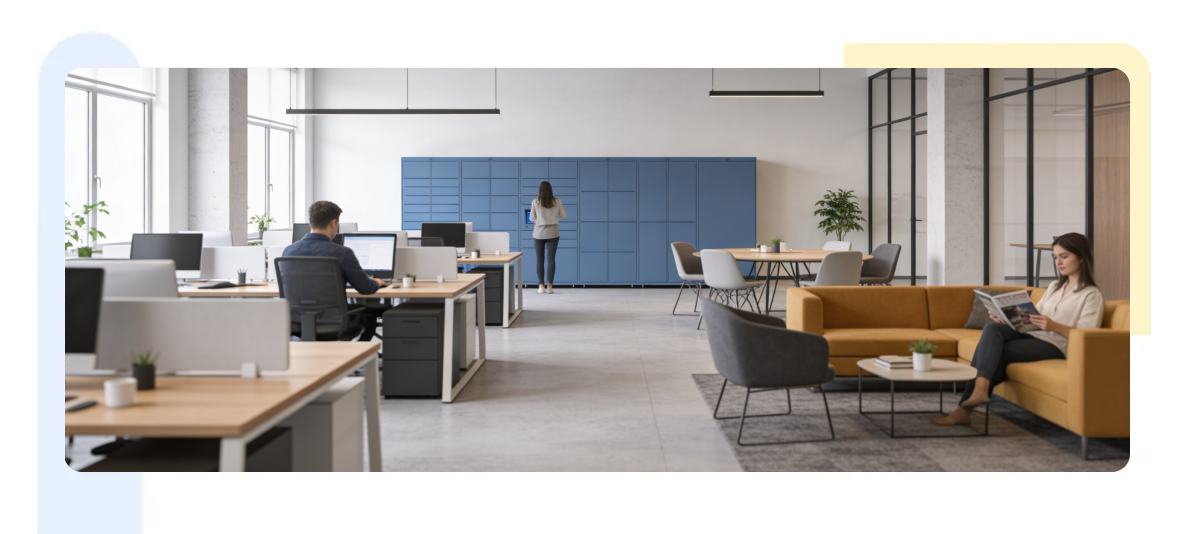
- Compact, design-forward hardware. Coworking spaces invest heavily in aesthetics. Your locker solution should complement your interior design, not clash with it. Smartbox units are available in a range of finishes and slim-profile configurations designed specifically for lobby and hallway settings.
- Transparent reporting. Operators need visibility into usage rates, occupancy by compartment, and any overdue pickups. The Smartbox dashboard provides real-time monitoring and weekly digest reports, keeping operations running without surprises.
Real-World Use Cases: Who Benefits Inside a Coworking Space
Smartbox serves different member types in different ways and understanding this helps operators communicate the value across their membership base.
Freelancers and solopreneurs receive personal and work packages at their coworking address without worrying about missed deliveries or packages left unattended at home. With Smartbox, they get an instant notification the moment a parcel arrives and can collect it on their own schedule.
E-commerce sellers, a rapidly growing segment using coworking spaces as lean fulfillment bases, need secure inbound receipt and outbound drop-off capability as part of their daily workflow. Smartbox handles both sides of that equation.
Enterprise teams require a professional, trackable delivery system that matches what they would expect in a traditional corporate office. Smart lockers signal operational maturity, and Smartbox’s audit trail and reporting capabilities give enterprise account managers the transparency they need.
Nomadic members who work across multiple coworking locations need reliable delivery infrastructure wherever they land. A Smartbox installation gives them confidence that their packages are handled consistently regardless of which location they are using.
Coworking operators themselves benefit from clean lobbies, empowered staff, and a defensible answer to the question every prospective member eventually asks: “What happens to my packages?”
The Smart Locker Market in 2026: Why Now Is the Right Time
The timing for coworking smart locker adoption has never been better, for two reasons.
First, the hardware and software have matured significantly. Early smart locker systems were expensive, rigid, and difficult to integrate. Today’s solutions, including Smartbox, are modular, cloud-managed, mobile-native, and priced for flexible deployment models including subscriptions that eliminate large upfront capital costs.
Second, the competitive environment demands it. The global smart locker market was valued at $3.71 billion in 2026 and is projected to reach $7.97 billion by 2032, growing at a 13.5% CAGR. As Smartbox and other providers expand installations across residential, retail, and university sectors, members increasingly arrive at coworking spaces with an expectation set by other environments, and an experience gap that creates friction.
Coworking operators who install Smartbox infrastructure now capture first-mover advantage in a segment that is, today, almost entirely unaddressed by major locker vendors.
Common Objections and Why They Do Not Hold Up in 2026
“We do not have the space.”
Smartbox units are designed for constrained commercial environments. Slim-profile, wall-mounted, and modular configurations mean most coworking lobbies, hallways, or back-of-house areas can accommodate a system with a minimal footprint. The Smartbox team conducts a free site assessment before any installation to confirm the best configuration for your space.
“Our members do not get that many packages.”
This tends to be an assumption, not a measurement. Most coworking operators who audit their front desk volume are surprised by how quickly deliveries add up, particularly when you factor in member business deliveries, equipment orders, client samples, and personal parcels. Smartbox can provide a volume estimate based on your membership size before you commit.
“It is too expensive.”
Smartbox removes the barrier of large upfront hardware costs by offering installment and emi options. And when you factor in the staff hours recovered, the liability risk reduced, and the revenue potential from premium add-ons, the ROI case for most medium-to-large coworking spaces is straightforward.
“Our members can just pick up from reception.”
They can, until you are closed. Or until your community manager is in a tour. Or until a package goes missing and no one can explain where it went. Reception-based package management works until it does not. And when it does not, the cost is measured in member trust. Smartbox removes that risk entirely.
How Smartbox Approaches Coworking Package Management
Smartbox was built for exactly this environment. Unlike locker vendors who adapted apartment solutions for commercial use, Smartbox’s smart locker systems are designed from the ground up for dynamic, multi-tenant spaces where the membership roster changes frequently and the operational team is focused on community, not logistics.
Key advantages for coworking operators:
- Real-time directory sync with leading coworking management platforms
- All-carrier acceptance with no pre-registration required for couriers
- Flexible compartment configurations from compact desk-side units to full lobby installations
- 24/7-member self-service with app-based, QR, and PIN access
- Live management dashboard with occupancy monitoring, overdue alerts, and usage analytics
- Design-forward hardware built to complement premium coworking interiors
Whether you operate a single boutique workspace or a multi-location co-working brand, Smartbox scales with your operation and gives your members an amenity they will actually talk about.
Conclusion: The Gap Is Closing Fast. Will You Be Ready?
Coworking operators have solved nearly every member friction point, except the one that happens dozens of times every day at the front desk. In 2026, smart lockers are the clearest unmet need in the flexible workspace industry, and the operators who move first will build a meaningful competitive advantage in member experience, staff efficiency, and enterprise sales.
The question is not whether coworking spaces need smart lockers. It is which operators will install them before their competitors do.
Ready to see what Smartbox looks like in your space? Book a free consultation with Smartbox today